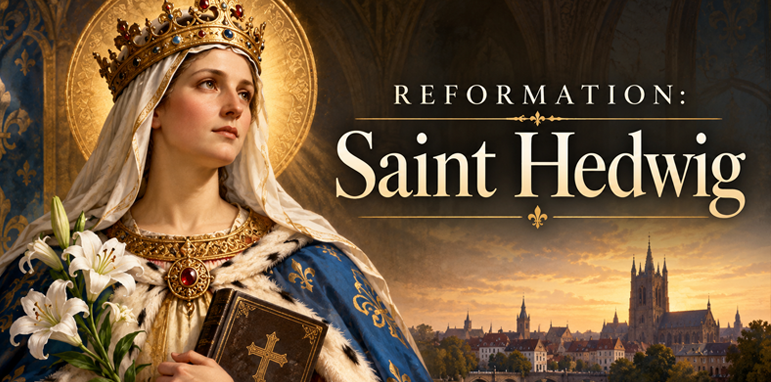
Among the communion of saints honored by the Church, there are a number of clergy, religious, royalty, mothers, fathers, husbands, wives, and holy people from all walks of life. But not many of them can claim to be a member of royalty, a wife, mother, and a nun like St. Hedwig can.
St. Hedwig of Silesia was a 12th and 13th century Bavarian duchess whose devotion to God led her as a strong Christian leader and eventually to the convent, following the death of her husband. The Church celebrates her feast day on Oct. 16.
Born in Andechs within the Holy Roman Empire in what is modern-day Germany in 1174, Hedwig was the daughter of a Bavarian nobleman. Her siblings would go on to high stations, including Queen of France, Queen of Hungary, Bishop of Bamberg, and a Benedictine abbess. Through her sister Agnes, Queen of Hungary, she is the aunt of St. Elizabeth of Hungary.
At the age of 12, Hedwig married Henry I the Bearded, the heir to the Duchy of Silesia. In 1201, she became Duchess Consort of Silesia. Hedwig and Henry went on to have seven children, including Henry II the Pious who succeeded his father as Duke of Silesia and later became the High Duke of Poland.
Throughout the reign of her husband, Hedwig encouraged him to support the poor, sick, as well as nuns and monks. She showed solidarity with the people of Silesia, learning the Polish language. Hedwig was a constant ambassador for the needy, willing to be amongst those who were destitute and donating much of her wealth. She even dressed the part, at times, throwing aside expensive and luxury dresses for humble attire.
After the death of her husband Henry in 1238, she entered Trzebnica Abbey, a Cistercian monastery which was established in 1202 by Henry at Hedwig's request. Although she did not take any vows, she lived as a lay sister, wearing a habit, living and prayer with her fellow Cistercian sisters. Her daughter, Gertrude, was also a Cistercian and later an abbess. Hedwig would continue to face heartache after her son, Henry II died at the Battle of Legnica, during the first Mongol invasion of Poland. Hedwig later helped found a Benedictine monastery at the battle site.
Hedwig died at Trzebnica Abbey on Oct. 15, 1243, at the age of 69. She is the patron saint of orphans, the Dioceses of Berlin and Görlitz, Kraków, Poland; and Silesia.
St. Hedwig of Silesia, pray for us!
