God invites everyone into His Kingdom, but we must answer His call with faith, humility, and a heart ready to live according to His will.
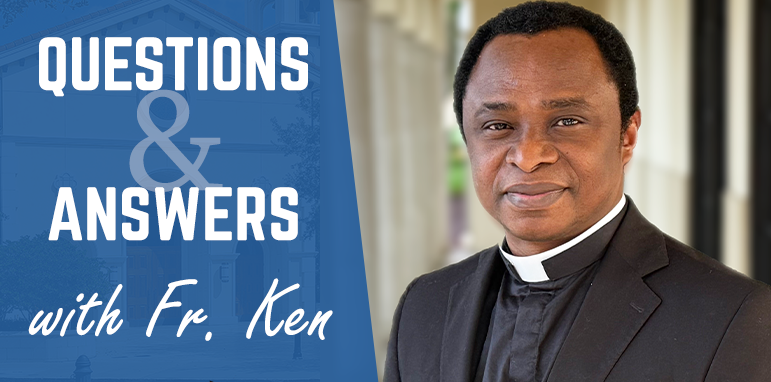 Fr. Ken is originally from Nigeria, was ordained to the Priesthood in 2011 and holds a doctorate in Canon Law from the Pontifical Lateran University in Rome, Italy. He has been appointed the Defender of the Bond for Matrimonial Cases in the Tribunal of the Diocese of Orlando. His ministry reflects a deep commitment to pastoral care, theological insight, and service to the People of God. His personal interests include soccer and table tennis (and bowling). He is a blessing to St. Margaret Mary Parish and we look forward to his clarification on Church “rules” according to Canon Law thru this weekly feature.
All parishioners are invited to submit a question to [email protected]. Fr. Ken will review selected questions and provide a thoughtful answer with reference to the Canon of the Catholic Church.
Jump to Previous Questions
JUDGING ACTIONS VS. BEING JUDGMENTAL: WHAT DOES JESUS REALLY MEAN?
QUESTION:
Father, I often hear people say, “Don't judge others,” and I find myself confused. What is the difference between judging someone’s actions and being judgmental toward a person? How can I correct someone when necessary, without being uncharitable or condemning?
ANSWER:
This is an important question, and one that causes confusion for many sincere Christians. In a culture where any form of correction is often labeled as “judgmental,” many people wonder whether it is ever appropriate to point out wrongdoing. At the same time, we know that charity, mercy, and respect for every person’s dignity must always guide our interactions. The Gospel equally calls us both to love others and to remain faithful to the truth.
The key distinction is this: Christians may make moral judgments about people’s actions, but we must be very cautious about judging the heart, intentions, or presume to know the state of their souls before God.
- The Scriptural Perspective
When Jesus says, “Judge not, that you be not judged” (Matt 7:1), He is not prohibiting moral discernment. Rather, He is condemning hypocritical and self-righteous judgment.
In the same chapter, Jesus teaches His followers to recognize false prophets by their fruits (Mt 7:15-20). This requires discernment and moral evaluation. Elsewhere, Christ instructs: “If your brother sins against you, go and tell him his fault between you and him alone” (Matt 18:15).
Similarly, St. Paul encourages believers to help one another return to the right path: “Brethren, if a man is overtaken in any trespass, you who are spiritual should restore him in a spirit of gentleness” (Galatians 6:1).
Therefore, Scripture distinguishes between condemning people and discerning whether an action is right or wrong. Christians are called to practice the latter while avoiding the former.
- The Theological Perspective
From a theological standpoint, God alone is the ultimate judge of the human heart. We can often determine whether an action is objectively good or evil because God has revealed moral truth through Scripture, natural law, and the teaching of the Church. For example, actions such as lying, perjury, theft, fraud, adultery, fornication, deliberate hatred, calumny, detraction, racism, abortion, euthanasia, human trafficking, the abuse of vulnerable persons, and other acts that directly contradict God’s law are objectively wrong, regardless of circumstances. The Church can identify these actions as morally disordered.
However, we cannot fully know the degree of another person’s personal responsibility before God. Only God sees the whole picture: a person's intentions, freedom, understanding, struggles, wounds, and circumstances.
The Catechism of the Catholic Church teaches: “Everyone should be careful to interpret insofar as possible his neighbor's thoughts, words, and deeds in a favorable way” (CCC 2478).
Thus, while we may say, “This action is wrong,” we should be very careful before concluding, “This person is bad,” or worse, presuming to know the person's eternal destiny. Theological charity requires us to distinguish the sinner from the sin, just as God Himself does.
- The Canonical Perspective
Although Canon Law is primarily concerned with the good order of the Church rather than personal moral judgments, it does recognize the responsibility of the faithful to care for one another’s spiritual welfare. Canon 212 §3 states that the faithful have the right and at times even the duty to make known their concerns for the good of the Church. This reflects the broader Christian responsibility to seek the truth and promote what is good.
Moreover, the Church’s canonical tradition has always valued fraternal correction as a work of charity. The purpose of correction is never punishment for its own sake, but the spiritual good of the person and the restoration of communion.
Canonically speaking, the Church is careful to distinguish between an external action and an individual’s internal culpability. While certain actions may have objective consequences in ecclesial life, the judgment of a person’s conscience ultimately belongs to God. This distinction mirrors the Church’s longstanding principle that we can evaluate external conduct, but we must exercise humility regarding the inner disposition of the soul.
- The Pastoral Perspective
Pastorally, the question is not simply whether we should correct someone, but how we do so. Before offering correction, we should ask ourselves:
- Am I motivated by love or by irritation?
- Do I genuinely desire this person's good?
- Have I examined my own faults first?
- Am I speaking with humility and respect?
A correction offered without charity can wound. Yet charity without truth can mislead. Authentic Christian love requires both. When correction becomes necessary:
- Speak privately whenever possible.
- Address the action rather than attacking the person's character.
- Listen before assuming motives.
- Offer encouragement alongside correction.
- Pray for the person before and after the conversation.
Pope Benedict XVI beautifully addressed this balance in his 2009 encyclical Caritas in Veritate (Charity in Truth). He teaches that authentic Christian charity can never be separated from truth, just as truth can never be separated from love. He writes that “charity rejoices in the truth” and insists that “to defend the truth, to articulate it with humility and conviction, and to bear witness to it in life are therefore exacting and indispensable forms of charity.” (Caritas in Veritate no. 1).
This insight is particularly relevant when discussing correction and judgment. If we emphasize truth without charity, our words can become harsh, condemning, and lacking compassion. On the other hand, if we emphasize charity without truth, we may avoid difficult conversations and fail to help others recognize actions that are harmful to themselves or their relationship with God and others. Christian discipleship requires both. Authentic love desires the good of the other person and therefore cannot remain indifferent to sin; yet authentic truth is always communicated with humility, patience, mercy, and respect for the dignity of the person. As Pope Benedict reminds us, charity and truth belong together because both find their fullness in Jesus Christ, who is at once the fullness of truth and the perfect revelation of divine love. Therefore, correcting someone is not inherently judgmental. In fact, when done humbly and lovingly, it can be a profound act of mercy. Being judgmental occurs when we place ourselves in God’s position, condemn others, or look down on them with pride.
In Summary
A Christian is called neither to ignore sin nor to condemn sinners. We are called to imitate Christ, who never compromised the truth yet always approached people with mercy, compassion, and hope.
We may judge actions in light of the Gospel, but we must leave the final judgment of persons to God.
Biblical Reflection
“Speaking the truth in love, we are to grow up in every way into him who is the head, into Christ.” (Ephesians 4:15)
This verse beautifully summarizes the Christian approach: truth without condemnation, charity without compromise, and correction rooted in love.
For more information on this, contact Fr. Ken Onyeabor at 407-647-3392 or email [email protected]
Previous Questions:
QUESTION: Father, can a Catholic Attend a Same-Sex Wedding? My friend is having a same-sex wedding, and I’m wondering if I can attend. First, I want to acknowledge the sincerity behind this question. It is clear that you desire to follow Christ faithfully and avoid choices that would contradict the teachings of the Church. Your desire not to offend God or misrepresent the Catholic faith is noble, and the Church deeply respects such conscientiousness. This question is not about judging anyone— it’s about understanding how a Catholic can live out the truth with both compassion and clarity. Let’s explore the answer. ANSWER: The Catholic Church’s teaching on marriage is not a cultural opinion, nor a negotiable pastoral guideline. It is a truth revealed by God, rooted in Scripture, affirmed by Tradition, and codified in Canon Law. Marriage is a covenant between one man and one woman. Canon 1055 §1 states: “The matrimonial covenant, by which a man and a woman establish between themselves a partnership of the whole of life… has been raised by Christ the Lord to the dignity of a sacrament between the baptized.” This canon expresses three essential truths: Sexual complementarity is essential to marriage, that is why Canon 1096 §1 further clarifies that “For matrimonial consent to exist, the contracting parties must at least not be ignorant that marriage is a permanent partnership between a man and a woman.” This canon presumes sexual complementarity as foundational to marriage. Unity and indissolubility Canon 1056 teaches that “The essential properties of marriage are unity and indissolubility…” These properties come directly from Christ’s own teaching (cf. Matthew 19:4–6). The Church cannot redefine marriage The Church does not have the authority to redefine what God Himself instituted. Marriage is not a human invention; it is a divine reality rooted in creation and revealed by Christ. Because of this, the Church’s role is not to adjust, update, or reshape marriage according to cultural trends or personal preferences. Her mission is to safeguard, preserve, and proclaim what Christ has revealed—nothing more and nothing less. For this reason, no human institution, government, court, ideology, or cultural movement can change the nature of marriage. Civil laws may redefine marriage on paper, but they cannot alter its essence. Cultural opinions may shift, but divine truth does not. The Church remains faithful to what God has established: marriage is a covenant between one man and one woman, ordered toward the good of the spouses and the procreation and education of children (cf. Canon 1055 §1). This question is not about personal choice, preference, or what one “feels” is right. A person’s individual belief—even sincerely held—cannot overturn or modify the teachings of the Church. Truth is not determined by majority vote, emotional appeal, or social pressure. It is received from God, handed down through Scripture and Tradition, and guarded by the Church across generations. In a world that often elevates personal choice above objective truth, it is essential to remember: our choices do not reshape God’s revelation. Fidelity sometimes requires standing against the current of modern culture, not because we lack compassion, but because we refuse to compromise what Christ Himself has entrusted to His Church. A Catholic may not attend a same‑sex wedding because attendance at a wedding is not a neutral act. It is a public sign of approval and support for the union being celebrated. Attending is a form of participation. The Church teaches that Catholics must avoid actions that: A same‑sex union, regardless of civil legality, cannot be a marriage in the eyes of the Church because it lacks the essential elements defined in Canon Law and divine revelation. To attend such a ceremony would be to: Pastoral charity does not mean compromising truth True charity is always rooted in truth. Charity without truth becomes sentimentality. Truth without charity becomes harshness. The Catholic way is truth spoken with charity, never truth diluted for comfort. The Church’s pastoral stance is clear: This is not about “who am I to judge?” This is: “I must be faithful to Christ and His Church.” A Catholic may: This approach: Holding firm to the Church’s teaching is not an act of judgment, it is an act of fidelity. In a culture that often pressures believers to compromise or remain silent, your desire to honor God and remain faithful to His truth is a sign of genuine spiritual maturity. It shows that your conscience is alive, formed, and attentive to the voice of Christ. Remaining faithful to the Church’s teaching on marriage may sometimes feel difficult, especially when it involves people you care about. Yet it is precisely in these moments that discipleship becomes real. Christ never promised that following Him would be easy; He promised that He would be with us. When you choose truth over convenience, clarity over confusion, and fidelity over cultural approval, you are walking in the footsteps of the saints who held fast to the Gospel in every age. The Church stands with you—not as an institution imposing rules, but as a mother who safeguards the truth that leads to authentic freedom and lasting peace. She supports you as you navigate challenging situations with both conviction and charity. And Christ Himself strengthens you. He sees your desire to be faithful. He knows the sacrifices you make for His sake. He honors the courage it takes to uphold His teaching in a world that often misunderstands it. Your fidelity is not isolation, it is witness. Your clarity is not harshness—it is love rooted in truth. And your steadfastness is not rigidity—it is the mark of a disciple who trusts that God’s plan is wiser, deeper, and more beautiful than anything the world can offer. Christ will give you the grace to stand firm, the wisdom to speak with charity, and the peace that comes from knowing you have chosen the path that leads to Him. Biblical Reflection “Do not be conformed to this world, but be transformed by the renewal of your mind, so that you may discern what is the will of God—what is good and acceptable and perfect.” (Romans 12:2) QUESTION: “Father, I was civilly divorced from my wife about 10 years ago. I never remarried because I still care for her, and I did not seek an annulment. Since I am not remarried, I have been receiving Holy Communion. But I want to understand something clearly: if I were to begin a romantic or sexual relationship with another woman, would the Church consider that adultery since my first marriage has not been declared null? And would such a relationship be a mortal sin?” Pastoral Introduction Many people carry deep wounds and complicated histories around marriage, divorce, and the desire for companionship. These experiences are often marked by love, loss, hope, and sometimes regret. The Church, like a mother, holds all of these stories with tenderness. She never approaches these questions with condemnation, but with the heart of Christ—who always speaks truth in a way that heals rather than harms. From time to time, faithful Catholics ask how their marital situation affects their relationship with God and their ability to receive the Sacraments. These questions are not merely legal or technical; they come from a place of sincerity, longing, and a desire to live rightly before the Lord. This week’s question reflects that sincerity. It comes from someone who has lived many years after a civil divorce, who has tried to remain faithful, and who now seeks clarity before making any decision that could affect his spiritual life. His question gives us an opportunity to explain—calmly, clearly, and compassionately—what the Church teaches about marriage, divorce, new relationships, and the reception of Holy Communion. My hope is that this explanation will not only answer the question but also offer encouragement to anyone who carries similar concerns. The Church’s teachings are never meant to burden us, but to guide us toward the freedom and peace that come from living in the truth. ANSWER: Thank you for this important and very honest question. Many Catholics struggle to understand what the Church teaches about divorce, remarriage, and relationships after a civil divorce. Your question touches on the heart of the Church’s teaching on the permanence of marriage and the meaning of fidelity. Let’s walk through this carefully and compassionately. The Church teaches that a valid sacramental marriage endures until the death of one of the spouses (cf. Catechism of the Catholic Church 1640). This is rooted in Christ’s own words: “What God has joined together, no human being must separate.” (Mark 10:9). A civil divorce may end the legal and social obligations of a marriage, but it does not dissolve the sacramental bond. Only death dissolves a valid marriage bond. This is why the Church teaches: The Code of Canon Law is explicit: Canon 1141 states “A valid marriage between baptized persons “cannot be dissolved by any human power nor by any cause other than death.” Canon 1151–1155: These canons acknowledge that spouses may separate for serious reasons, but separation does not grant freedom to enter a new union. Canon 1085 §1 has it that “A person bound by a prior marriage “invalidly attempts marriage” if the prior bond has not been proven null. This canon expresses the Church’s consistent teaching: the prior bond remains until the Church judges otherwise. Because you remain bound to your first marriage, entering a romantic or sexual relationship with another woman would constitute a violation of marital fidelity. The Church calls this objectively: If all three are present, the act becomes a mortal sin, which ruptures communion with God and the Church. You are not remarried. You are not living in a sexual relationship. You are striving to live according to the Church’s teaching. Civil divorce alone does not prevent a Catholic from receiving Holy Communion. The Catechism states in CCC 2384–2386 that Civil divorce is a grave matter when it unjustly breaks a marriage, but it does not in itself bar a person from the Sacraments. The Church welcomes, supports, and accompanies divorced Catholics who are striving to live faithfully. If you were to begin a romantic or sexual relationship with another woman without an annulment, the Church would understand this as: This is not a punishment. It is simply the consequence of living in a state that contradicts the sacramental reality of marriage. The Church’s discipline here is pastoral, not punitive. It is meant to protect the dignity of the Sacraments and to encourage the faithful to live in the truth. If you believe your first marriage may have been invalid from the beginning, the Church invites you to seek a decree of nullity. This is not “Catholic divorce.” It is a careful, respectful examination of whether the marriage was truly what the Church understands marriage to be. If the marriage is declared null: If the marriage is upheld: Either outcome provides clarity, peace, and a path forward. Your question shows a sincere desire to live in communion with Christ and His Church. Your desire to remain faithful to your first marriage, even after civil divorce, is something the Church deeply respects. It reflects a heart that takes the sacrament seriously. Please know that the Church walks with you. You are not alone. The Tribunal exists to help the faithful understand their situation and discern God’s will with clarity and hope. If you ever choose to begin the annulment process, it is not a judgment against you or your former spouse. It is simply a search for truth—truth that brings freedom. Biblical Reference “What God has joined together, no human being must separate.” (Matthew 19:6) ANSWER Thank you for bringing forward a question that many parishioners quietly wrestle with but often feel hesitant or even embarrassed to ask. It touches on something deeply personal—how we show reverence to God—and something beautifully communal—how we relate to one another as brothers and sisters in Christ. Naming this tension requires pastoral sensitivity, spiritual maturity, and genuine love for the Church. Your willingness to voice it is a real service to our parish. It opens the door for thoughtful reflection, clearer teaching, and deeper understanding. It also models for your children, and for all of us, that questions about faith and reverence are not signs of doubt but signs of devotion. By asking this, you help us grow both in our respect for the sacredness of God’s house and in our appreciation for the warmth of Christian community. Your question is a gift—one that allows families, catechists, and parishioners to reflect more intentionally on how we honor Christ’s presence and how we care for one another within His Church. Now, let’s dive into the explanation. A brief, quiet, friendly exchange after Mass is not irreverent. But loud or extended conversation inside the church—especially while others are praying—does not reflect the reverence due to the Eucharistic Presence. The Church encourages both prayerful silence in sacred spaces and warm community life, but each in its proper place. The Mass formally ends with the dismissal (“Go forth…”), but the sacred presence of Christ in the Eucharist remains. The church building continues to be a place of prayer, thanksgiving, and quiet reverence. After receiving Holy Communion, the Church encourages a moment of personal prayer, often called thanksgiving after Communion. Many Catholics kneel or sit quietly for this reason. So, while the liturgy has ended, the sacredness of the space has not. This is why some remain in silence: they are praying, thanking God, or simply resting in His presence. Silence in church is not a matter of policing behavior; it flows from what the Church believes about sacred spaces and about Christ’s abiding presence. A. Canon Law: What a Sacred Space Is Meant to Foster Canon law does not prohibit conversation in church, but it does define the purpose of a church building: Canon law is not trying to create a library-like atmosphere; it is articulating the identity of the space. Because the building is consecrated for worship, the behavior within it should harmonize with that purpose. B. Theology: The Real Presence Shapes the Atmosphere The deeper reason silence matters is theological, not legal. The church is not only a gathering hall—it is the dwelling place of the Real Presence of Christ in the tabernacle. This changes everything. Because Christ is truly present: In other words, silence is not merely etiquette; it is a way of acknowledging Who is in the room. C. Tradition: How Catholics Have Expressed Reverence Across centuries and cultures, Catholics have instinctively shown devotion in sacred spaces through: These practices are not arbitrary rules—they are expressions of love, humility, and awareness of God’s presence (For more details on this section, check out Fr. Chris teaching Mass on the parish website) Here is the pastoral tension: The pastoral solution is simple and gentle: A. Charity: Silence as a Gift to Other This is the pastoral heart of the matter. Even if one person has finished praying, the person next to them may be in the middle of a profound moment of thanksgiving, grief, discernment, or consolation. Silence protects that moment. Silence is a way of saying: Thus, silence is not primarily about rules, it is about charity. It is a way of loving the person who is praying next to you. B. The Balance: Reverence Inside, Fellowship Outside The Church desires both: Both are good. Both are necessary. But they belong in different places: This balance teaches children—and adults—that reverence is not about being rigid or unfriendly. It is about honoring Christ and respecting the prayer of others. Here are child-friendly principles you can teach: Children understand this easily when framed as respect and kindness, not as strict rules. For the children you teach, you might say something like: “After Mass, some people stay to talk to Jesus quietly in their hearts. Others are excited to see friends. Both are good, but they belong in different places. In church, we keep our voices soft and our conversations short, so we don’t disturb anyone praying. Once we step outside, we can talk and laugh as much as we want.” This gives them clarity without shaming anyone they see. Biblical Reference “The Lord is in His holy temple; let all the earth keep silence before Him.” Habakkuk 2:20 QUESTION: Father, how often should I go to confession This is a very important and very sincere question, because many Catholics genuinely want to grow spiritually but are unsure how frequently they should approach the Sacrament of Reconciliation. Some fear going “too often,” others worry they don’t go enough, and many simply want clarity so they can form a healthy, grace‑filled sacramental life. Your question touches the heart of conversion, spiritual maturity, and the rhythm of Christian discipleship. Canon Law gives us the minimum: This is the bare minimum—not the ideal. The Church sets a minimum because she knows human weakness, but she invites us to much more because she knows the power of grace. So canonically, If someone falls into mortal sin, they should go to confession as soon as possible. If someone is not in mortal sin, they are still encouraged to go regularly. Theologically, confession is not only about forgiveness, but also about healing, strength, and conversion. The Catechism of the Catholic Church teaches that frequent confession: The Saints and spiritual directors of the Church have always recommended monthly confession — or even every two to four weeks — not because they believed people were constantly falling into grave sin, but because they understood something essential about the human heart: Confession is not a Sacrament for emergencies. It is a sacrament for growth. It is not only for the moment when we fall hard. It is for the daily reality that we are human. A. Regular Confession Keeps the Heart Awake Just as dust settles on a table even when no one touches it, so spiritual dust settles on the soul even when we are trying to live well. None of these are dramatic, but they accumulate. They slowly dull our spiritual senses. Confession wipes the dust away and restores clarity. B. Regular Confession Strengthens the Will The Saints knew that the human will weakens when left unattended. Confession is like a spiritual gym: A person who confesses regularly becomes spiritually resilient. C. Regular Confession Heals What We Don’t See We often notice only the “big sins,” but the small wounds matter too: Confession brings these into the light. Grace heals what we didn’t even know was hurting us. D. Regular Confession Restores Joy The saints went frequently not because they were scrupulous, but because they loved the joy of being close to Christ. E. Regular Confession Keeps Us Humble Humility is not humiliation. Humility is truth. Confession keeps us grounded in reality: This humility protects us from pride, self-righteousness, and spiritual complacency. F. Regular Confession Helps Us Love Better Every sin — even small ones — affects our relationships: Confession purifies the heart so we can love more freely, more generously, more like Christ. G. Confession Is Spiritual Maintenance This is why the analogy is so powerful: So too, we confess regularly — not because we are terrible, but because we are human. Confession is the sacramental “maintenance” of the heart. It keeps the soul running smoothly. It keeps grace flowing freely. It keeps our spiritual life healthy, balanced, and alive. Above all, regular confession is not about guilt. It is about growth. It is not about shame. It is about freedom. It is not about fear. It is about friendship with Christ. The saints knew this. The Church teaches this. And our hearts long for this. For those battling recurring sins—anger, impatience, lust, gossip, unforgiveness, addictions—the Church encourages more frequent confession, not less. Why? Because grace strengthens the weak. Confession is not only a remedy for past sin—it is a medicine for future strength. A person who is sincerely trying to grow will benefit from: Frequent confession becomes a lifeline, not a burden. Even those who do not fall into grave sin still benefit from regular confession. Venial sins weaken charity, cloud judgment, and slowly erode spiritual sensitivity. Confession restores clarity, peace, and spiritual sharpness. It is like polishing a mirror so that Christ’s light can reflect more clearly. Here is the Church’s balanced, pastoral answer: Minimum: Healthy Practice: The Church never discourages the sinner who is trying. She walks with them, strengthens them, and invites them to the healing grace of the Sacrament. Scripture Reference “Create in me a clean heart, O God, and renew a right spirit within me.” — Psalm 51:10 This verse captures the heart of confession: God renews, restores, and strengthens the soul that comes to Him with humility. QUESTION: Father, can someone receive Communion if they are struggling with habitual sin but sincerely trying to change?” ANSWER: This is a very important and very honest question, because many sincere Catholics carry this struggle quietly. They love God, they come to Mass, they want to grow—but they also battle patterns of sin that do not disappear overnight. Your question touches the heart of the Church’s teaching on grace, conversion, and the Eucharist. Before answering, let’s place the question in its proper perspective: The issue is not simply “habitual sin,” but whether the person is in a state of mortal sin or sincerely striving to live in God’s grace. The Church never discourages the sinner who is fighting to rise again. The Church teaches that the Eucharist is medicine for the soul, strength for the journey, and grace for those who are trying to grow. Jesus did not institute the Eucharist for the flawless, but for the struggling. However, the Church also teaches that receiving Communion requires being in a state of grace (CCC 1385). This means: So, the key question becomes: Is the person struggling with habitual sin in a state of mortal sin, or sincerely fighting against it with repentance and the desire to change? Canon Law is very clear: Communion must be withheld only from those who obstinately persist in manifest grave sin (canon 915). This means: Most habitual sins do not meet these criteria. A person who is sincerely trying to change—who confesses regularly, seeks help, prays, and desires conversion—is not obstinately persisting. They are fighting. They are struggling. They are trying. Canon Law does not punish the struggler. Canon Law protects the Sacraments while encouraging conversion. The Church distinguishes between: A. Habitual sin with repentance This is when someone falls repeatedly but: This person is on the path of conversion. They may receive Communion if they are not in mortal sin at that moment. B. Habitual sin without repentance This is when someone: This person should not receive Communion until they return to grace through confession. The difference is the heart. The struggler is moving toward God. The unrepentant is moving away from Him. Receiving Communion while sincerely striving to overcome sin can be a powerful source of grace. The Holy Eucharist strengthens the will, heals wounds, and gives supernatural help. But the Eucharist cannot be received in mortal sin. So, the pastoral path is: The Church never discourages the sinner who is trying. The Church walks with them. The Church understands that conversion is rarely instantaneous; it is usually a slow, grace‑filled journey marked by victories, setbacks, and renewed effort. A person who is sincerely striving to change—who acknowledges their weakness, seeks God’s mercy, and refuses to give up—is already cooperating with grace. The Church does not push such a person away from the sacraments; she draws them closer, because the sacraments are precisely the means by which God strengthens the weak, heals the wounded, and lifts up those who fall. Like a mother guiding a struggling child, the Church accompanies, encourages, and supports every soul that desires to grow, reminding them that God delights more in their effort than in their perfection. “A bruised reed He will not break, and a smoldering wick He will not quench.” — Matthew 12:20 So, can someone receive Communion if they are struggling with habitual sin but sincerely trying to change? Yes—provided they are not in a state of mortal sin and are sincerely striving to live in God’s grace. Habitual sin does not automatically exclude someone from Communion. Obstinate, unrepentant sin does. The struggler belongs to the altar. The one who has surrendered to sin belongs first in the confessional. Biblical Reference “A bruised reed He will not break, and a smoldering wick He will not quench.” — Matthew 12:20 Jesus does not reject the struggling sinner; He strengthens them. The Eucharist is part of that strength. QUESTION: “Father, why does the Church baptize infants who cannot yet profess faith? Isn’t that unfair to the child’s freedom?” ANSWER: Thank you for asking this thoughtful and very relevant question. Many Catholics who were not raised in the faith—or who come from Christian communities that practice only adult baptism—often wonder why the Catholic Church baptizes infants. Your question reflects a sincere desire to understand the Church’s teaching more deeply, and it gives us an opportunity to explain the beauty, purpose, and grace of infant baptism. It is a question worth asking, and one that deserves a clear and compassionate answer. The Church’s law is rooted in her belief that Baptism is not merely symbolic—it truly gives grace. This obligation is not burdensome—it is an act of love. Just as parents provide food, safety, and education, they also provide the supernatural life of grace. The heart of the Church’s teaching is simple: Grace comes first. Our response comes later. Infants cannot profess faith, but the Church professes faith on their behalf—just as parents make countless life‑shaping decisions for their children before they can speak or choose. Parents do not wait for a child to “choose”: Likewise, they do not wait for the child to “choose” eternal life. Baptism is a gift, not a reward for understanding. Some worry that baptizing an infant “forces” religion upon them. In reality, Baptism expands the child’s freedom. Grace strengthens human freedom; it does not replace it. A baptized child grows up with: Baptism does not remove freedom—it equips it. The New Testament records several “household baptisms”: In the ancient world, “household” in Greek language oikos included children and infants. The early Church understood Baptism as the entrance into the Christian life for all, not only adults. The earliest Christian writers testify that infant baptism was already the norm: This is not a medieval invention—it is apostolic. Parents naturally want the best for their children. Baptism gives: Delaying Baptism delays grace. The Church encourages infant baptism because she wants children to grow up with God’s life in them, not without it. In Summary The Church baptizes infants because Baptism is God’s gift of salvation, not a human achievement. Parents have the loving duty to give their children every good thing—natural and supernatural. Baptism does not restrict a child’s freedom; it strengthens it with grace. From the earliest days of Christianity, the Church has welcomed infants into the life of Christ, trusting that God’s love reaches them even before they can speak His name. Biblical Reflection “Let the little children come to me, and do not hinder them.” — Mark 10:14 QUESTION: Father will please explain to me why antisemitism has been a problem for so many years. ANSWER: You’re asking a big, painful question—and it’s a good one. Antisemitism isn’t just a “topic,” it’s a wound that has marked history and still bleeds today. Let’s walk through it carefully and honestly. Antisemitism is hostility, prejudice, or discrimination against Jews simply because they are Jews. It’s not a disagreement about politics or theology; it’s a deep, irrational hatred that turns a whole people into a target. It has taken many forms over the centuries: In the ancient world, Judaism was unusual: it believed in one God in a world of many gods. That alone made Jews stand out and sometimes be mistrusted. With the rise of Christianity, things became more complicated. Jesus was Jewish, and the first Christians were Jews. But as Christianity spread, some Christians began to see Jews as those who “refused” to accept Jesus as the Messiah. Over time, a terrible idea took root: that “the Jews killed Christ” and were therefore cursed or rejected by God. It was used to justify: The involvement of some Jews leaders does not justify blaming “the Jews” as a whole. The phrase “the Jews killed Christ” is historically inaccurate because: A. Most Jews at the time had no involvement whatsoever. The Jewish population was spread across Judea, Galilee, Samaria, and the entire Mediterranean world. The vast majority never heard of Jesus until after the Resurrection. Blaming “the Jews” as a whole is false, unjust, and contrary to the Gospel. B. The Gospels show that many Jews supported Jesus. His disciples, His followers, the crowds who welcomed Him on Palm Sunday — all were Jewish. C. The term “the Jews” in John’s Gospel often refers specifically to certain Judean authorities, not the entire people. D. Collective guilt is never morally or theologically acceptable. You cannot attribute the actions of a few leaders to an entire people, across time and history. Note: Rome alone had the legal authority to crucify. Crucifixion was a Roman method of execution. Only the Roman governor could authorize it. So historically: This is why the Church says: “What happened in His passion cannot be charged against all the Jews, without distinction, then alive, nor against the Jews of today.” (Nostra Aetate, 4). This is not denying the involvement of certain Jewish leaders. It is rejecting the false leap from some leaders → all Jews. Theologically, the Church says: In medieval Europe, Jews were often a small minority, visibly different in religion and customs. They were sometimes forced into certain professions (like moneylending) because other jobs were closed to them. That made them easy targets when people were angry or afraid. Terrible myths arose: These lies fueled violence and massacres. Whenever society was in crisis—war, plague, economic collapse—Jews were often blamed. In the 19th century, with the rise of nationalism and pseudo‑science, antisemitism took on a new form: racial antisemitism. Jews were no longer just seen as a “wrong religion,” but as an “inferior race” that could never truly belong, even if they converted. This “scientific racism” was completely false, but it was used to justify: The Nazis built on centuries of religious and social antisemitism and turned it into a program of genocide—the Holocaust—where about six million Jews were murdered simply for being Jewish. Antisemitism persists because it is useful to hatred: In our own time, antisemitism can appear: From a Christian perspective, antisemitism is not just wrong—it is sinful and incompatible with the Gospel: We are called to: Antisemitism has lasted so long because fear, ignorance, and hatred are stubborn. But the Gospel calls us to something different: truth, humility, and solidarity. What the Catholic Church Teaches About Jews Nostra Aetate, the Declaration on the Relation of the Church to Non‑Christian Religions is one of the major documents of the Second Vatican Council (1962–1965). The document addresses the Church’s relationship with: It is the most important modern Church document on Judaism. It changed the tone of Catholic teaching forever. Here are the key teachings: A. The Jewish people remain beloved of God Nostra Aetate states that the Church “draws sustenance from the root of that well‑cultivated olive tree” which is Israel. This means: B. Jews must never be blamed for the death of Jesus This is one of the strongest statements in the document: “What happened in His passion cannot be charged against all the Jews, without distinction, then alive, nor against the Jews of today.” (Nostra Aetate, §4). This is the section where the Fathers of the Second Vatican Council explicitly reject the idea of collective Jewish guilt for the death of Christ and condemn all forms of antisemitism. This directly rejects centuries of false accusations that fueled antisemitism. C. The Church condemns all hatred, persecution, and antisemitism Nostra Aetate says: “The Church decries hatred, persecutions, and displays of antisemitism directed against Jews at any time and from any source.” (Nostra Aetate, §4). This is not optional. It is a binding moral teaching. D. Christians and Jews share a spiritual bond The document emphasizes: Christianity cannot understand itself without Judaism. St. John Paul II did more than any Pope in history to heal the relationship with the Jewish people. He said: A. “The Jewish people are our elder brothers.” This phrase became a cornerstone of Catholic-Jewish dialogue. B. The covenant with Israel is “irrevocable.” He taught that God’s promises to the Jewish people remain valid forever. C. Antisemitism is a sin against God and humanity. He called antisemitism: “A sin against God and man.” He visited synagogues, prayed at the Western Wall, and publicly asked forgiveness for Christian sins against Jews. 3. Pope Benedict XVI: Clarifying Theology Pope Benedict XVI emphasized: A. Jews are not replaced by Christians In his work Jesus of Nazareth: Holy Week (2011), Benedict rejects “replacement theology” (also called supersessionism). He explains that the Church does not replace Israel but is grafted onto Israel’s covenantal relationship with God. He bases this on St. Paul’s teaching in Romans 9–11. B. God’s covenant with Israel stands In the same work (Jesus of Nazareth: Holy Week, 2011), Benedict writes that God’s fidelity to Israel is irrevocable, and that the Jewish people remain in a living covenant with God. He emphasizes that this covenant is part of the “mystery of salvation” and cannot be undone. C. The Jewish people have a unique role in salvation history They are not simply “one religion among many,” but the people through whom God revealed Himself. Pope Francis has continued this teaching with warmth and clarity. A. “A Christian cannot be antisemitic.” In this speech, Pope Francis said clearly: “A Christian cannot be antisemitic; we share the same roots.” “It is a contradiction for a Christian to be antisemitic. The roots of Christianity are Jewish.” (Address to Delegation of the Simon Wiesenthal Center, January 20, 2020). This is one of his strongest and most explicit condemnations of antisemitism. B. Jews and Christians are family Pope Francis said: “You are our elder brothers and sisters.” (Visit to the Great Synagogue of Rome, January 17, 2016). He repeated the language used by St. John Paul II, emphasizing the familial bond between Christians and Jews. He frequently used the phrase “my Jewish brothers and sisters”, showing his long-standing personal commitment to Jewish–Christian friendship. C. He condemns modern antisemitism strongly Pope Francis warned: “Antisemitism is a virus that mutates and never disappears. It must be confronted with firmness.” (Address to Delegation of the American Jewish Committee February 11, 2020). He equally said: “Sadly, antisemitism is still present today. We must condemn it in all its forms.” (Address to International Jewish Committee for Interreligious Consultations, June 24, 2013) The Church’s teaching is not just historical, it is urgent. A. Antisemitism is rising again We see it in: B. Christians must be the first to reject it Because: C. Antisemitism contradicts the Gospel You cannot love Christ and hate the people He came from. You cannot worship the God of Israel and despise Israel. The Church teaches clearly: Nostra Aetate opened the door. John Paul II, Benedict XVI, and Francis walked through it. Biblical Reference “For the gifts and the call of God are irrevocable.” — Romans 11:29 QUESTION Father, during Eucharistic Adoration, is it liturgically proper for the priest or deacon to walk around with the monstrance and bless each person individually? I have seen this done in some youth settings, and it feels very powerful, but I want to be sure it is truly in line with the Church’s liturgical norms. ANSWER Thank you for asking this. It is a courageous and deeply important question because it touches the heart of our Eucharistic faith and the reverence we owe to the Real Presence of Christ. Many people wonder about this practice but hesitate to ask. Your desire to understand what the Church teaches—and to worship the Eucharist with both devotion and obedience—is a sign of genuine faith. This question gives us the opportunity to clarify how the Church intends us to adore Christ in the Blessed Sacrament, and how we can honor Him with both love and liturgical fidelity. Let’s dive into the topic! The Church provides clear guidance for Eucharistic Adoration and Benediction in: When we say, “The Church provides clear guidance for Eucharistic Adoration and Benediction in HCWEOM, the Ceremonial of Bishops, and Redemptionis Sacramentum,” we are referring to the official, authoritative books that govern how the Eucharist may be handled outside of Mass. These documents are not commentaries or suggestions — they are the actual liturgical law of the Church. They tell priests and deacons exactly what they may and may not do with the Blessed Sacrament. Here is what each one covers: A. Holy Communion and Worship of the Eucharist Outside Mass (HCWEOM) This is the primary Liturgical Book for Eucharistic Adoration. It gives the step‑by‑step instructions for: This book does not include any provision for walking around with the monstrance or giving individual blessings. It envisions the priest giving one solemn blessing from the altar⸺Benediction B. Ceremonial of Bishops This book describes how bishops celebrate liturgical rites, including Eucharistic Adoration. It reinforces the same structure: Even when a bishop presides — the highest liturgical authority in the diocese — he does not give individual blessings with the monstrance. If the bishop does not do it, priests and deacons certainly may not. C. Redemptionis Sacramentum (2004) This is a document from the Congregation (now Dicastery) for Divine Worship that addresses abuses and clarifies liturgical discipline. It emphasizes: This document (RS) explicitly states that no one may add, remove, or change anything in the liturgy on their own authority. Since individual blessings with the monstrance are not found in any liturgical book, they fall into the category of unapproved additions. None of these documents permit the priest or deacon to walk around the church giving individual blessings with the monstrance. Why this Matters These documents together form the official, universal instructions for Eucharistic Adoration throughout the entire Catholic Church. They ensure that: So, when we say, “The Church provides clear guidance,” it implies that the Church has already told us exactly how Adoration and Benediction are to be done — and individual blessings with the monstrance are not part of the rite. The Church envisions one solemn Eucharistic blessing, given from the altar, at the conclusion of Adoration. This blessing is communal, not individual. Canon Law protects the integrity of liturgical rites. Canon 846 §1 states: “The liturgical books approved by competent authority are to be faithfully observed… no one may add, remove, or change anything in them on one’s own authority.” Walking around with the monstrance to bless individuals is considered an addition to the rite—something not found in the liturgical books. Therefore, it is not permitted, even with good intentions. The Church’s discipline is not meant to limit devotion, but to protect the dignity of the Eucharist and ensure unity in worship. The Eucharist is not a sacramental object used to give multiple personal blessings. The Eucharist is Christ Himself. The Church intends the Eucharistic blessing (Benediction) to be: The priest does not “apply” the Eucharist to individuals like holy water or a relic. Instead, the Eucharist is adored in stillness, and the blessing is given to the entire assembly at once, symbolizing Christ’s universal love and presence. Walking around with the monstrance risks: The Church’s theology emphasizes adoration, contemplation, and communal blessing, not individualized distribution of Eucharistic benedictions. Many youth groups, retreat communities, and prayer gatherings request individual blessings because: These desires are good. They reflect a longing for closeness to Christ. But good desires must be guided by the Church’s wisdom. The Church protects the Eucharist from practices that—even unintentionally—reduce reverence or alter the meaning of the rite. The goal is not to suppress devotion, but to channel it properly. A. Eucharistic Processions A reverent procession may bring the Eucharist closer to the people—without stopping for individual blessings. B. Pausing Near Groups The priest or deacon may pause briefly in certain areas, allowing the faithful to adore more closely. C. Inviting the Faithful to Come Forward Encouraging people, especially youth—to kneel near the altar during Adoration is fully permitted and often deeply moving. D. Teaching the Beauty of Benediction The one solemn blessing at the end expresses the Church’s belief that Christ blesses all of us together, as one family. Many people remember moments during Adoration when the priest brought the monstrance close for an individual blessing. Those gestures were offered out of sincere pastoral love and a desire to help the faithful feel personally near to Jesus in the Eucharist. Your devotion, reverence, and longing for Christ have always been deeply valued. With clearer guidance now available regarding liturgical norms, the Church invites us to honor that devotion while also celebrating the beauty of the communal nature of Eucharistic worship. Here is the heart of the matter: “We want to adore Jesus in the way the Church teaches us. The Eucharistic blessing is meant to be communal, not individual. We can still bring Jesus close to you through a reverent procession, but the blessing itself will remain the solemn Benediction at the altar.” Nothing is being taken away. The Lord remains just as present, just as close, and just as eager to pour His grace into the hearts of all who come before Him. What is changing is simply the manner in which we express our worship—aligning our practices with the Church’s liturgical tradition, where Christ blesses the entire community together. Your devotion is good. Your desire for closeness with Jesus is good. Your love for the Eucharist is good. And we will continue to foster opportunities for profound, reverent, and authentic encounters with the Lord in Adoration. Biblical Reference “Let all things be done decently and in order.” — 1 Corinthians 14:40 QUESTION: “Father, when I read the story of the Prodigal Son, I see a young man who freely chooses to walk away from his father, and a father who allows that freedom even though it leads to pain. But I also see a father who never stops loving, never stops waiting, and runs to meet his son the moment he turns back. How does this parable help me understand the way God respects my freedom—even when I misuse it—and at the same time offers mercy so generously? What does this reveal about the kind of relationship God desires with us, where both choice and grace are at work?” ANSWER: Why this question matters in our faith journey This is a deep and important question, because it touches the very heart of the Christian life: You are not just asking about a parable—you are asking about the kind of relationship God desires with us: not forced, not fearful, but free, trusting, and rooted in mercy. This is a sign of grace: your heart is seeking to understand God not as an idea, but as a Father. In the parable (Luke 15:11–32), the younger son freely chooses to leave his father’s house. He asks for his inheritance early—a shocking request in that culture, almost like saying, “I wish you were dead.” And yet, the father does not force him to stay. This reveals something profound about God: The father’s willingness to let the son go is not indifferent, it is the painful respect of a loving parent who knows that freedom is part of love. God allows us to walk away, not because He wants us far from Him, but because He refuses to violate the dignity He Himself gave us. The son’s journey away from home leads to: This is not because the father punishes him from afar, but because life cut off from the source of love and wisdom naturally collapses. Sin carries its own consequences. The parable shows that: Yet even in that far country, the son is not forgotten. The father’s heart remains turned toward him. The key moment in the story is when the son “comes to himself” (Luke 15:17). He realizes: Notice something here: This is grace at work: Our freedom and God’s grace meet at this point: I choose to turn; God chooses to receive. The most shocking part of the parable is the father’s reaction: This reveals the heart of God: Here we see that: Our freedom opens the door; His mercy fills the house. The son returns with a plan: “I will say, Treat me as one of your hired servants.” But the father refuses this. He does not want a servant; he wants a son. This shows us: In our life with God: The older brother represents another kind of struggle: He resents the mercy shown to his brother. He sees himself more as a slave than a son: “All these years I served you…” The father goes out to him too and says: “Son, you are always with me, and all that is mine is yours.” This teaches us: Putting it all together: The parable reveals that God’s respect for our freedom and His overflowing mercy are not opposites but expressions of the same divine love. He honors our ability to choose—even when our choices lead us far from Him—and yet His love is shown even more fully in the joy with which He welcomes us home. Biblical Takeaway “But while he was still a long way off, his father saw him and was filled with compassion; he ran to his son, embraced him and kissed him.” (Luke 15:20) QUESTION: “Why does the Church insist on objective moral truth when society says morality is personal and subjective? Isn’t that outdated?” ANSWER: Before we explore this important question, it’s worth pausing to acknowledge the courage behind it. In a modern culture that often treats morality as nothing more than personal preference—“my truth,” “your truth,” “whatever feels right”—it takes real honesty and spiritual maturity to ask whether there might be something deeper, something objective, something true. Many people simply go along with the cultural tide; few are willing to stop and wonder whether freedom without truth is actually freedom at all. The very act of raising this question shows a heart that is searching, a conscience that is awake, and a desire for clarity that is already the beginning of conversion. Let’s jump in. DEPARTURE Our modern culture prizes choice and freedom—but often understands them as the ability to do whatever I want, whenever I want, as long as I “feel” it’s right. Morality becomes: In this view, any claim that something is objectively right or wrong sounds oppressive or outdated. But the Church insists that true freedom is not freedom from truth, but freedom in the truth. When the Church speaks of objective moral truth, she means: The Catechism of the Catholic Church teaches: “The natural law expresses the original moral sense which enables man to discern by reason the good and the evil, the truth and the lie.” (CCC 1954) And: “There are acts which, in and of themselves, independently of circumstances and intentions, are always gravely illicit by reason of their object.” (CCC 1756). In other words, some things are wrong always and everywhere—no matter how sincerely someone feels otherwise. Saint John Paul II’s encyclical Veritatis Splendor (“The Splendor of Truth”) is one of the Church’s clearest responses to modern moral relativism. He writes: “Truth enlightens man’s intelligence and shapes his freedom, leading him to know and love the Lord.” (Veritatis Splendor, §84). This section appears within John Paul II’s profound reflection on the relationship between freedom and truth, where he explains that authentic human freedom is never opposed to truth but is formed and elevated by it. And John Paul II warns: Man, “giving himself over to relativism and skepticism… goes off in search of an illusory freedom apart from truth itself.” (Veritatis Splendor, § 32). In this section, St. John Paul II explains that when human beings detach freedom from truth, they fall into relativism and skepticism, believing that freedom means creating one’s own morality. But this “freedom” is an illusion, because without truth, freedom loses its direction and becomes self-destructive. So: If there is no objective moral truth, then: The Church refuses to accept that. She insists that some things are truly good, and some things are truly evil, because God is real, human dignity is real, and love has a real shape. Modern culture often says: “Morality is personal. What’s right for you may not be right for me.” But this breaks down quickly. The Church insists on objective moral truth precisely to protect human dignity and defend the vulnerable. Without objective truth, the strong decide what is “right,” and the weak suffer. Our age loves the word freedom, but often forgets responsibility. The Church teaches that: “The more one does what is good, the freer one becomes.” (CCC 1733) And John Paul II in Veritatis Splendor insists: “There can be no freedom apart from or in opposition to the truth.” So: When society says, “Morality is personal and subjective,” it is really saying, “I want freedom without limits.” But the Church responds: a freedom that refuses truth eventually destroys itself. To call objective moral truth “outdated” assumes that truth changes with time. But: The Church believes that moral truth is rooted in: These do not expire with cultural trends. Veritatis Splendor of John Paul II was written precisely to address the claim that traditional moral teaching is outdated. John Paul II responds: “No one can escape from the fundamental questions: What must I do? How do I distinguish good from evil?” (VS § 32). He explains that every human being—no matter the culture, era, or personal beliefs—must confront the basic moral questions: He argues that these questions are unavoidable because they arise from the very structure of human reason and conscience. Even when modern culture tries to reduce morality to personal preference, the human heart still longs for truth, meaning, and direction. Those questions are as urgent today as ever. So why does the Church insist on objective moral truth? ARRIVAL The Catechism of the Catholic Church summarizes: “Man tends toward the good, but his nature bears the wound of original sin. He is inclined to error and must be enlightened by God’s revelation and by the moral law.” (cf. CCC 1949–1950). Objective moral truth is not a cage; it is a light. It shows us: A word to the troubled heart If you feel troubled by the clash between modern culture and the Church’s teaching, that’s not a bad sign—it means your conscience is awake. The Church is not trying to take away your freedom. She is trying to protect your freedom from lies. Objective moral truth is not outdated; it is the only thing that can keep love, justice, and human dignity from being swallowed by opinion and power. Biblical reference “You will know the truth, and the truth will set you free.” (John 8:32) Truth and freedom are not enemies. In Christ, they belong together. “If God forgives everything, why does the Church still teach about Hell? Is it really possible for someone to be eternally separated from God?” ANSWER: This is one of the most important and challenging questions a Christian can ask because it touches directly on our eternal destiny—the final purpose for which we were created. Questions about Heaven, Hell, judgment, and mercy are not abstract theology; they shape how we live, how we love, and how we respond to God’s grace. The Church takes this question seriously because Jesus Himself takes it seriously. The Church does not invent teachings about Hell; she simply hands on what Christ revealed. In fact, the Gospel for the 17th Sunday in Ordinary Time, Year A (Matthew 13:44–52) includes Jesus’ own words about the final judgment: “The angels will go out and separate the wicked from the righteous and throw them into the fiery furnace, where there will be wailing and grinding of teeth.” (Matthew 13:49–50). These are not the Church’s words. They are Christ’s. Yet we live in an age that is deeply uncomfortable with the idea of Hell. Many would prefer that the word be erased from the Church’s vocabulary altogether. But removing the word does not remove the reality. And avoiding the topic does not help us grow in holiness or freedom. The question is therefore not only important—it is urgent. Yes, God’s mercy is infinite. Scripture proclaims this repeatedly: When we say, “God forgives everything,” we are proclaiming a central truth of the Christian faith: God’s mercy is infinite, unconditional, and always offered. But this truth must be held together with another equally important truth: God created us with real freedom, and He never violates that freedom — not even to save us. A. Mercy Is Not Magic — It Is a Relationship Mercy is not a mechanical act that God performs automatically. It is not a spiritual “reset button” that erases sin without involving the human heart. Mercy is fundamentally relational. It is God extending His hand, His grace, His forgiveness — and waiting for us to take that hand. God’s mercy is like a physician offering a cure. The cure is real. The cure is free. The cure is effective. But the patient must consent to receive it. B. Forgiveness Must Be Received Throughout Scripture, forgiveness is always offered, but it is never forced: These passages reveal a profound truth: God respects our freedom even when we misuse it. C. God Will Not Impose Salvation Salvation is union with God. Union requires love. And love, by its very nature, cannot be forced. If God forced salvation on someone who persistently rejected Him, it would not be love — it would be spiritual imprisonment. God desires children, not hostages. Saint Augustine expresses this beautifully: “God created us without us, but He will not save us without us.” This is not a limitation of God’s power. It is the perfection of His love. D. The Heart of the Matter: God Forgives Everything — But Not Everyone Accepts His Forgiveness. This is the central tension of Christian anthropology. God’s mercy is infinite. Human freedom is real. And the tragedy of sin is that a person can freely, persistently, and definitively reject the mercy that is offered. Hell is not the result of God refusing to forgive. Hell is the result of a human being refusing to be forgiven. The Catechism of the Catholic Church states this clearly: “To die in mortal sin without repenting and accepting God’s merciful love means remaining separated from Him forever by our own free choice.” (CCC 1033) Notice the language: These are relational, voluntary acts. God offers mercy, but He does not override the human will. E. The Mystery of Freedom: Love can be rejected. This is the sobering but necessary truth: A person can say “no” to God — not just temporarily, but definitively. Hell is the eternal “No” of a human heart that refuses God’s eternal “Yes.” C.S. Lewis famously summarized it this way: “The doors of Hell are locked on the inside.” Not because God locks them, but because the soul refuses to open them. F. Why This Matters Spiritually This teaching is not meant to frighten us. It is meant to awaken us to: God’s mercy is always greater than our sin — but it is never imposed against our will. The Church teaches about Hell for one reason: Jesus taught about Hell more than anyone else in the Bible. He speaks of: Christ’s warnings are not threats; they are expressions of love. He speaks of Hell not to frighten us, but to awaken us to the seriousness of our choices and the dignity of our freedom. The Church, as Mother and Teacher, simply echoes her Lord. Yes—but not because God desires it. Hell is not a punishment God inflicts. Hell is the final consequence of a freely chosen rejection of God’s love. The Catechism teaches: “To die in mortal sin without repenting and accepting God’s merciful love means remaining separated from Him forever by our own free choice.” (CCC 1033) This means: Heaven is freely chosen union with God. Hell is freely chosen separation from God. Both are rooted in love and freedom. Our age is allergic to the idea of consequences. We prefer comfort over conversion, affirmation over repentance, and sentimentality over truth. The word “Hell” feels harsh, outdated, or incompatible with a loving God. But this discomfort says more about our culture than about God. This statement is not suggesting that God wants to say “no” to us. Rather, it highlights a profound truth about love, freedom, and the nature of God’s relationship with us. A. Love Always Involves Freedom For love to be real, it must be freely given and freely received. If God were incapable of saying “no to our freedom and choice,” then His “Yes” would not be meaningful. It would be automatic, mechanical, and forced — not personal, relational, or loving. B. God’s “Yes” Is Meaningful Because It Is Free God’s love is not an instinct or a reflex. It is a free, intentional, personal choice. He chooses us. He desires us. He loves us deliberately. And because His love is free, it is also true. C. God’s Respect for Human Freedom Mirrors His Own Freedom God created us in His image, which means: If God could not say “no to our freedom and choice,” then He would not be respecting the dignity of our freedom. He would simply override us, absorb us, or force Himself upon us — which is impossible for a God who is love. D. Hell Reveals the Seriousness of Love Hell is not God saying, “I refuse to love you.” Hell is God saying: “I respect your freedom so deeply that I will not force you to love Me.” If God could not allow a person to reject Him, then He would be denying the very freedom He gave us. And without freedom, real love cannot exist. E. A God Who Cannot Say “No to our Freedom” Would Be a God Who Cannot Love If God were incapable of saying “no to our freedom and choice,” then: In other words, He would not be a God of love but a God of intimidation. The God revealed in Scripture is, however, a God who loves and a God who respects freedom, even when that freedom is sadly misused. Here is the beautiful paradox: God wills everyone to be saved, and He provides everything for us to be saved. But He will not force anyone to be saved. Mercy is offered to all, but accepted by some, resisted by others, and sadly rejected by a few. Hell exists because love can be refused. The doctrine of Hell is not meant to terrify us but to motivate us: The Church teaches about Hell not to condemn, but to call us to the joy of Heaven. Christ’s warnings are invitations to life. 10. A Final Pastoral Word Hell is real. God’s mercy is real. Our freedom is real. But the greatest truth is this: No one is predestined for Hell. Everyone is offered Heaven. And God pursues every soul until the final breath. The doctrine of Hell is ultimately a doctrine about the seriousness of love and the dignity of human freedom. It is not a message of fear, but a message of hope—because it reveals how far God will go to respect the freedom of His children, even when they tragically misuse it. Biblical References QUESTION: I believe in the sanctity of life and that suicide and/or euthanasia is wrong in the eyes of God. But does God want us to prolong our lives with more treatments if there isn't a cure? ANSWER: Thank you for these thoughtful and deeply personal questions. In summary, you’re asking: “When suffering becomes overwhelming, what does the Church teach about desiring death, refusing treatment, DNR orders, and donating one’s body?” These questions touch the intersection of faith, suffering, medical ethics, and human dignity—a place where many Catholics quietly struggle. It takes real courage to ask them openly, and your honesty helps our whole parish grow in compassion and clarity. These questions are not abstract. They come from real human pain, real medical situations, and real spiritual wrestling. The Church approaches them with truth and tenderness, always protecting the dignity of the human person while recognizing the limits of human suffering. Q1. “Is it a sin to want to die when suffering is overwhelming?” The short answer: No. It is not a sin to desire relief from suffering or even to wish for death in the sense of longing for God to call us home. Many saints expressed this same longing. What is sinful is actively choosing death through suicide or euthanasia. But the desire for suffering to end is a human response, not a moral failure. Catholic Sources Supporting Question 1 The Church distinguishes between: This distinction is rooted in several magisterial texts. A. Catechism of the Catholic Church (CCC) CCC 2280–2282 These paragraphs condemn suicide and euthanasia, but they also acknowledge the psychological and physical burdens that can diminish culpability. They make clear that sin lies in the act of taking life, not in the feeling of wanting suffering to end. “We are stewards, not owners, of the life God has entrusted to us.” (CCC 2280). This supports the idea that wanting relief is human, but choosing death is not permitted. B. Spe Salvi (Pope Benedict XVI, 2007) Pope Benedict speaks directly about the human experience of suffering and the longing for release. He notes that Christians may desire to “depart and be with Christ,” echoing St. Paul (Phil 1:23). This supports the point “a desire for heaven is not sinful. C. St. Paul’s own witness Philippians 1:23 Paul expresses a holy longing for death (“I desire to depart and be with Christ”), yet he does not choose death. This is a biblical foundation for distinguishing holy longing from sinful action. D. Evangelium Vitae (St. John Paul II, 1995) John Paul II strongly condemns euthanasia and suicide, but he also speaks with compassion about those who suffer deeply. He teaches that: This supports the statement that the desire for relief is not sinful. E. Declaration on Euthanasia (Congregation for the Doctrine of the Faith, 1980) This document acknowledges: The document reinforces the distinction: wanting suffering to end ≠ choosing death. Many saints expressed a holy desire for heaven: This supports the point that holy longing is part of Christian. So, the Church teaches that: This distinction matters. A desire for heaven is not the same as choosing death. Q2. “Is it a sin to refuse treatments that only prolong life but cannot cure the condition?” The Church makes a clear distinction between: Ordinary (proportionate) care Treatments that offer reasonable hope of benefit without excessive burden. Extraordinary (disproportionate) care Treatments that: Catechism of the Catholic Church (CCC 2278) teaches that: The more recent document Samaritanus Bonus (Congregation for the Doctrine of the Faith, 2020, approved by Pope Francis) restates the same teaching: The document also emphasizes that: St. John Paul II in Evangelium Vitae reaffirms the same principle that there is no obligation to use medical treatments that are “disproportionate” to the expected results and rejecting such treatments is not euthanasia. Also, in his 1957 address to the International Congress of Anesthesiologists, Pope Pius XII shared: The Church teaches that no one is morally obligated to accept extraordinary care. Refusing burdensome treatments—such as another major surgery or chemotherapy with no curative hope—is not a sin. It is a morally legitimate decision. This is not “choosing death.” It is choosing natural dying rather than aggressive prolongation. Q3. “Is it a sin to refuse Cardiopulmonary Resuscitation (CPR) by signing a Do Not Resuscitate (DNR) order?” A DNR is morally acceptable when the medical situation warrants it. The Church teaches: CPR can be extremely violent and often ineffective in patients with advanced illnesses. Signing a DNR is not a sin when: A DNR is not euthanasia. It is allowing natural death to occur without extraordinary intervention. Q4. “Does the Church approve of donating one’s body or organs?” Yes. The Church strongly supports organ donation and body donation for medical research as acts of charity. Catechism of the Catholic Church has that “Organ donation after death is a noble and meritorious act and is to be encouraged.” (CCC 2296). It teaches that: St. John Paul II in Evangelium Vitae called organ donation: “A genuine act of love.” He also teaches: The recent Vatican document Samaritanus Bonus approved by Pope Francis reaffirms: This document also clarifies that: This is a beautiful way to give life even in death. Q5. “Does God want us to prolong life at all costs?” No. The Church teaches that life is sacred, but also that death is a natural part of life. We are called to preserve life, not to force life at any cost. God does not require: What God desires is: We prolong life when it is reasonable. We allow natural death when it is time. Biblical Reflection “Come to me, all you who labor and are burdened, and I will give you rest.” — Matthew 11:28 Christ does not ask us to carry unbearable burdens. He invites us into peace, trust, and the gentle acceptance of God’s timing. QUESTION Father, my 8‑year‑old son has been invited to a playdate at his friend’s home. His friend is being raised by two women in a same‑sex relationship. I genuinely like this family and know they are good people, and my son very much wants to continue this friendship. At the same time, I want to protect him from confusion. I am trying to teach him both the Gospel truth about the dignity of every human person and God’s plan for marriage between a man and a woman. How can I help him navigate this situation while safeguarding his innocence and staying faithful to what the Church teaches? ANSWER Thank you for this question. It takes courage, love, and deep faith to ask how to guide a child in situations where the world’s realities differ from the Church’s teachings. Your desire to protect your child’s innocence while honoring the dignity of every person reflects the heart of a Christian parent. Your question is not only valid, but also important, and many parents quietly wonder about the same thing. You are trying to hold together two truths: You are also trying to protect your child’s innocence without isolating him from friendships or from the real world he must eventually navigate. This tension is not a contradiction—it is the very space where Christian charity and formation meet. Every person—without exception—is created in the image and likeness of God. This includes people in same‑sex relationships. The Catechism of the Catholic Church teaches that persons with same‑sex attraction “must be accepted with respect, compassion, and sensitivity” (CCC 2358). This means: Your child should see you model this respect. The Church teaches that marriage is not merely a social arrangement or a cultural preference. It is a covenant, a sacrament, and a reality rooted in creation and Christ’s own teaching. Canon Law expresses this with remarkable clarity: A. Marriage is a Covenant Canon 1055 §1 “The matrimonial covenant, by which a man and a woman establish between themselves a partnership of the whole of life… has been raised by Christ the Lord to the dignity of a sacrament between the baptized.” The Church does not describe marriage as a contract but as a covenant—a lifelong, total partnership. B. Marriage Requires Sexual Complementarity Canon 1055 §1 “…a man and a woman establish between themselves a partnership of the whole of life…” Canon 1096 §1 “For matrimonial consent to exist, the contracting parties must at least not be ignorant that marriage is a permanent partnership between a man and a woman…” Here, Canon Law presumes and protects the truth that marriage is inherently between one man and one woman. C. Marriage Is Ordered Toward the Good of the Spouses and the Procreation/Education of Children Canon 1055 §1 “The matrimonial covenant …is ordered by its nature to the good of the spouses and the procreation and education of offspring...” This canon mirrors the teaching of Gaudium et Spes of Second Vatican Council and the Catechism of the Catholic Church that marriage is both unitive and procreative. D. Marriage Is Rooted in Christ’s Teaching Canon 1056 “The essential properties of marriage are unity and indissolubility, which in Christian marriage obtain a special firmness by reason of the Sacrament.” This canon reflects Christ’s own words in Matthew 19: “What God has joined together, let no one separate.” E. Marriage Is a Sacramental Bond Canon 1134 “From a valid marriage there arises between the spouses a bond… and a partnership of the whole of life.” Marriage is not simply a legal reality—it is a Sacramental bond that shapes the entire life of the spouses. The Church’s teaching on marriage is clear, but it does not instruct Catholics to avoid, reject, or distance themselves from individuals whose family structures differ from this teaching. Canon law emphasizes parents’ duty to form their children. Canon 226 §2 states “Parents have the most serious obligation and enjoy the right to educate their children… according to the teaching of the Church.” This means: Children at this age do not experience moral confusion. They experience categorical confusion: “Why does he have two moms?” “Where is his dad?” They are not questioning doctrine—they are noticing differences. This means: You simply need to give your child a clear, simple category. Here is language that protects innocence of your child and teaches truth: “Some families look different from ours. In our family, God made moms and dads to love each other in marriage. In your friend’s family, he has two women who take care of him. We treat everyone with kindness, and we always remember what God teaches us about marriage.” This explanation: Canon Law does not prohibit Catholic children from interacting with families whose structures differ from Church teaching. What Canon Law does require is: Your responsibility is formation, not isolation. Here are practical steps that uphold truth and charity: Stay Present Debrief Gently Ask: Avoid interrogating the family structure. Reinforce Catholic Teaching Calmly Later, in a peaceful moment, remind your child: Model Charity Your child learns more from your tone than your words. Your child is learning something profound: This is precisely the formation a Catholic child needs. Allowing your child to attend the playdate does not mean you approve of everything about the adults’ relationship. It means you are choosing: This is the Catholic way. Biblical Reflection “Let all that you do be done in love.” — 1 Corinthians 16:14 Love does not erase truth, and truth does not erase love. In Christ, they belong together QUESTION Father, “If I forget to confess a mortal sin because I genuinely forgot, am I still forgiven? Or do I need to go back and confess it again?” ANSWER Many Catholics quietly struggle with this very concern but rarely find the courage to ask it. For those with tender or scrupulous consciences, the fear of “forgetting something” in confession can become a heavy burden—one that causes anxiety, doubt, and even discouragement in their spiritual lives. This question is honest, sincere, and far more common than people realize. Bringing it forward is an act of trust in God’s mercy and a desire to understand the Sacrament more deeply. The Church meets this question with clarity, compassion, and the reassurance that God’s forgiveness is not limited by our imperfect memory. With that in mind, let us proceed to the clarification. If you genuinely forgot a mortal sin when you went to confession, and you intended to confess all your sins, you are forgiven. The absolution you received covers that sin as well. However, once you remember it later, you should mention it in your next confession, not because you are still in mortal sin, but out of honesty and reverence for the Sacrament. So: This is the Church’s consistent teaching and is meant to calm scrupulous hearts, not to trap them in fear. The Code of Canon Law lays down the basic obligation: “A member of the Christian faithful is obliged to confess in kind and in number all grave sins committed after baptism and not yet directly remitted through the keys of the Church nor acknowledged in individual confession, of which one is conscious after diligent examination of conscience.” (Canon 988 §1) Key points: Therefore, a confession is valid and fruitful when: Please note: If a mortal sin is deliberately withheld, the confession is invalid and the sin is not forgiven. But if it is honestly forgotten, the confession is valid and the sin is forgiven—though it should be confessed when remembered. The Catechism explains the attitude of the penitent: “When Christ’s faithful strive to confess all the sins that they can remember, they undoubtedly place all of them before the divine mercy for pardon. But those who fail to do so and knowingly withhold some, place nothing before the divine goodness for remission through the mediation of the priest.” (CCC 1456) Notice the distinction: So: For someone who is scrupulous, this is crucial: God judges the heart and the intention, not the perfection of your memory. St. Thomas Aquinas addresses this very question: “Whether a general confession suffices to blot out forgotten mortal sins?” (Summa Theologiae, Supplement, q.10, a.5). He concludes: However, Aquinas also says: This is exactly what the Church continues to teach today. The Council of Trent, in its teaching on the Sacrament of Penance, emphasizes: Applied here: For someone struggling with scrupulosity, this question often hides a deeper fear: “What if I didn’t do it perfectly? What if God is still angry?” The Church’s answer is gentle but firm: This is not “re-confessing” something unforgiven; it is bringing into the light what God has already forgiven, so that your conscience can be at peace and your honesty before God is complete. A good rule of thumb for the scrupulous: God’s mercy is larger than your memory. The Sacrament of Reconciliation is designed to heal, not to torment. Biblical Reflection “If we confess our sins, he is faithful and just, and will forgive our sins and cleanse us from all unrighteousness.” (1 John 1:9) This verse reminds us that God’s faithfulness and justice—not our perfect recall—are the foundation of our forgiveness. Why does the Church require annulments when two people clearly weren’t compatible from the start? Is not that just a Catholic version of divorce? ANSWER This question comes up constantly among many Catholics. Many people have experienced painful marriages, difficult separations, or civil divorce, yet have never been taught the difference between civil divorce and the Church’s declaration of nullity (commonly called “annulment”). For many, the process feels confusing: If two people obviously weren’t compatible, why does the Church require an annulment? Isn’t that just our version of divorce? This is a deeply relevant question, and answering it clearly helps people heal, discern, and understand the Church’s pastoral care for marriage. WHAT ANNULMENT ACTUALLY IS WHAT IT IS NOT A declaration of nullity does not end a valid marriage. It simply states that a valid marriage never came into existence because something essential was missing at the time the vows were exchanged. Canon law is explicit: The Church does not “undo” a valid marriage. If the marriage was validly contracted, no one—not even the Pope—can dissolve it (can. 1141). This is why the Church requires a tribunal process. Compatibility problems after the wedding do not automatically prove invalidity. Why the Tribunal Must Examine the Moment of Consent When the Church evaluates a marriage, she is not asking, “Did the couple eventually get along?” or “Did the marriage later become difficult?” She is asking a very specific juridical question: What was the reality at the moment the couple exchanged consent? In Canon Law, consent makes marriage (can. 1057). Everything hinges on that moment. A couple may experience serious incompatibility later—arguments, emotional distance, financial conflict, personality clashes—but these later developments do not automatically prove that something essential was missing on the wedding day. The tribunal must therefore investigate three key areas: It must examine whether the capacity, freedom, and intention were present on the wedding day. A. Capacity (Can. 1095) Did each party possess the psychological, emotional, and relational maturity required to assume the essential obligations of marriage? This includes the ability to: A person may appear “normal” externally but still lack the interior capacity required for valid consent. This incapacity must be present at the time of the wedding, not merely discovered later. B. Freedom (Canon 1103) Was the person free from force or grave fear? If someone married because of: then, the consent may not have been truly free. Again, this must be proven as a condition existing at the moment of consent, not simply assumed from later unhappiness. C. Intention (canon 1101 §2) Did either party exclude something essential to marriage? For example: These intentions can be hidden, subconscious, or masked by outward behavior. The tribunal must determine whether such exclusion existed at the wedding, not merely because the marriage later broke down. Many couples discover incompatibility early on—sometimes even on the honeymoon. But incompatibility after the wedding does not necessarily mean the marriage was invalid at the wedding. The tribunal must determine whether the incompatibility was rooted in something present before or at consent. Many couples discover incompatibility only after living together: These may be symptoms of a deeper issue, but they are not themselves canonical grounds for an annulment. The tribunal’s task is to discern whether the incompatibility was rooted in a pre‑existing defect that made valid consent impossible. This requires: Only after this investigation can the Church say with moral certitude whether a valid marriage was ever brought into existence. Civil divorce Annulment (Declaration of Nullity) The Church’s teaching is rooted in Jesus’ words: “What God has joined together, no human being must separate.” (Matthew 19:6). Because the Church believes marriage is indissoluble, she cannot “end” a valid marriage. She can only determine whether one ever existed. TERMS TO BE CLARIFIED The Church recognizes that spouses may need to live apart for serious reasons—abuse, danger, grave conflict, or adultery. Separation does not end the marriage bond. The spouses remain married but no longer cohabit. Civil divorce is sometimes tolerated when necessary to protect legal rights, children, or property. It is a civil remedy, not a sacramental judgment. It does not free a Catholic to marry again without an annulment. This is rare and applies only in specific situations: These are not annulments. They dissolve a real marriage under special circumstances. THE HEART OF THE MATTER: A PASTORAL VIEW The Church’s annulment process is not about judging people or assigning blame. It is about truth, healing, and freedom. Annulment is not a loophole, not a Catholic divorce, and not a punishment. It is the Church’s way of honoring Jesus’ teaching while caring for wounded hearts. If you have additional questions about children born during a marriage that is later declared null, or concerns about adult children and the annulment process, please email [email protected] A WORD OF HOPE “The Lord is near to the brokenhearted and saves the crushed in spirit.” — Psalm 34:18 God meets us in our wounds, our questions, and our longing for healing. The Church’s process exists not to burden people, but to help them walk toward truth, peace, and the freedom to love again in Christ. Question: Father, I keep hearing that missing Mass on Sunday is a mortal sin, but what if someone is overwhelmed, depressed, or spiritually exhausted? Does the Church consider those circumstances? Answer: Canon Law and Moral Theology both insist that true moral responsibility depends on authentic human freedom, and this freedom can be diminished or even impaired by serious internal suffering. This principle is not a modern invention—it is deeply rooted in the Church’s understanding of the human person, conscience, and the nature of sin. Moral Responsibility Requires Freedom Canon Law presumes that a person is morally responsible only when they act with sufficient use of reason and freedom of the will. Canon 1321 §1 teaches that a person is not liable for a moral offense unless it is committed with deliberate intention. In other words, the law itself recognizes that internal suffering affects freedom, and therefore affects moral responsibility. Moral Theology Teaches the Same (CCC 1857–1859) The Catechism of the Catholic Church explains that for a sin to be mortal, three conditions must be present: Grave matter CCC 1857 A. Objectively a grave matter CCC 1857 teaches that for a sin to be mortal, the act itself must involve grave matter. The Church considers the Sunday Eucharist a serious obligation because it is: The center of Christian life Therefore, deliberately missing Mass without a serious reason is objectively grave. This describes the action, not the person’s guilt. This means that grave matter describes the action. Mortal sin describes the person’s full responsibility. They are not the same thing. Serious action does not always mean serious guilt.” B. Full knowledge CCC 1858 explains that the person must know that the act is seriously wrong. C. Full consent of the will CCC 1859 teaches that the person must freely choose the action. Full consent means the person is not acting under fear, emotional collapse, psychological distress, or internal pressure that limits freedom. Depression, anxiety, burnout, or spiritual desolation can significantly weaken a person’s ability to make a free and deliberate choice. When freedom is impaired, full consent is lacking, and therefore mortal sin is not present. Internal Suffering Can Limit Freedom The Church understands that: Depression can paralyze a person’s ability to act. The Church does not simply look at whether someone missed Mass. She looks at the whole person, their freedom, their mental and emotional state, and their capacity to choose. The Catechism of the Catholic Church insists that mortal sin is not just about the external action—it is about the interior freedom of the person. And when that freedom is wounded, diminished, or overwhelmed, the Church responds with understanding, compassion, and pastoral care. Therefore, the Church absolutely recognizes that human beings are not machines, and that our emotional, psychological, and spiritual states can profoundly affect our freedom. Someone who is overwhelmed, depressed, anxious, grieving, or spiritually exhausted may not be capable of making a fully free and deliberate choice. Depression, for example, Can drain a person’s energy In all these cases, the Church does not presume mortal sin. Instead, she looks at the whole person with compassion, recognizing that grave psychological or emotional burdens can reduce or even remove personal culpability. This is why the Church always encourages a person in these circumstances to speak with a priest—not for judgment, but for clarity, healing, and support. The goal is never to trap someone in guilt, but to help them rediscover God’s love and regain spiritual strength. The Lord sees the heart, and He knows the difference between someone who rejects Him and someone who is simply hurting, exhausted, or overwhelmed. At the same time, the Church gently encourages anyone struggling with these burdens to seek help—spiritual, emotional, or medical—because God desires their healing and wholeness. Returning to Mass, even slowly or imperfectly, is part of that healing, not a burden placed on the weak. In short: Yes, the Church absolutely considers these circumstances. She always distinguishes between the objective seriousness of missing Mass and the subjective freedom of the person. And she always responds with mercy, understanding, and the heart of a loving Mother. Biblical Quotation “Come to me, all you who labor and are burdened, and I will give you rest.” (Matthew 11:28) For the Lord does not see as man sees; man looks on the outward appearance, but the Lord looks on the heart.” 1 Samuel 16:7 ANSWER: This is an important and courageous question. Many Catholics see a gap between what the Church teaches about the Eucharist and how some approach Holy Communion. Acknowledging this tension honestly is not judgmental—it is a sign of deep faith, reverence, and a desire to understand the mystery of the Holy Eucharist more fully. Thank you for asking because it is a question many quietly hold but hesitate to express. To address this question, we need to keep in mind the following: 1. What the Church teaches about the Holy Eucharist The Catholic Church professes that the Eucharist is truly, really, and substantially the Body and Blood of Jesus Christ (Catechism of Catholic Church 1374). This means: It is Christ Himself — Body, Blood, Soul, and Divinity. Because of this, the Church teaches that receiving Holy Communion is the most sacred act a Catholic can perform. 2. Why do some Catholics receive Holy Communion casually? For many years, religious teaching (Catechesis) in some places focused more on community and symbols than on the Real Presence of Jesus in the Holy Eucharist. Many adults have not received ongoing formation since childhood, so their understanding remains at a grade‑school level. Surveys consistently show that a large percentage of Catholics do not believe in the Real Presence — not out of rejection, but out of never having been taught. If people don’t understand that the Holy Eucharist is a sacrifice and not just a meal, it becomes harder for them to show reverence. Some Catholics assume that “everyone receives, so it must be fine,” because they have never been taught about interior disposition or gravity of mortal sin. Catechesis is not about pointing fingers — it’s about helping fix what was missing in people’s faith formation over the years. b. Cultural Habit: For some, Holy Communion has become a routine part of Mass rather than a conscious encounter with the living Christ. In many parishes, the Communion line moves so quickly that people may feel rushed, and this can make receiving the Holy Eucharist feel more like an ‘assembly line’ or something to ‘grab and go’ than a sacred moment of meeting Christ. When something sacred like receiving Holy Communion becomes familiar, the human heart can become desensitized — not out of malice, but out of routine. Modern life pushes us to rush through everything, but the Holy Eucharist invites us to slow down and meet Jesus with reverence. For many people living in a busy, distracted world, slowing down like this is not easy. Many Catholics were never taught or never saw examples of strong Eucharistic reverence, such as silence, kneeling, or staying to pray after receiving Holy Communion. In some places, the absence of silence before or after Holy Communion makes it harder to enter into a contemplative disposition. If the Mass is done in a hurried or casual way, the people usually follow that attitude. c. Spiritual Lukewarmness: Some people receive the Eucharist without preparing their hearts — not because they are rebelling, but because they are tired, overwhelmed, or distracted. Many Catholics are weighed down by work, family pressures, and emotional burdens. When life feels overwhelming, it becomes harder for them to slow down and approach the Eucharist with the reverence it deserves. People may be physically present at Mass but mentally scattered, making it difficult to enter into the mystery of the Holy Eucharist. Some Catholics have lost the habit of daily prayer, making the Holy Eucharist feel disconnected from their interior life. Spiritual dryness — When someone feels far from God for a while, it becomes harder for them to show reverence at Mass. Without regular Confession, the soul gradually loses sensitivity to sin and the need for preparation toward the reception of the Holy Communion. The devil’s most subtle temptation is not hatred of God, but indifference. Being lukewarm is not a judgment — it’s God inviting you to start again. d. Social Pressure: People sometimes go forward simply because “everyone else is going,” even if they are not spiritually ready. In many parishes, almost everyone goes up for Holy Communion, so staying seated can make a person feel very noticeable. Family expectations can be strong — During family gatherings such as weddings, funerals, and holidays, some Catholics feel pressure from relatives to go up for Communion, and this pressure can make it hard for them to follow their conscience. Children and teens often copy what adults do at Mass, even when they don’t fully understand the Eucharist. Without good examples, they may not learn how to approach Jesus in the Holy Eucharist with reverence. Some Catholics were never taught that there are moments when a person should refrain from receiving Holy Communion — not because receiving is unimportant, but because the Holy Eucharist deserves to be approached with a heart properly prepared. In certain cultures, not going up for Holy Communion can be seen as disrespectful or embarrassing. Because of this pressure, some people receive even when their hearts are not ready. People sometimes fear gossip or misunderstanding if they don’t go up for Holy Communion — even from their own spouse, who might lean over and whisper, “Are you okay? Why didn’t you go?” — so they end up receiving even when they know they shouldn’t. Social pressure is not a moral failing — it is a human reality that requires pastoral sensitivity. e. Woundedness or Fear: Some are afraid to abstain from Holy Communion because they fear being judged by others. Many Catholics carry hidden wounds from past sins or painful experiences in the Church. When it’s time to receive the Holy Communion, these wounds can make them feel torn — unworthy to receive, yet afraid to remain in their pew. Others have been judged or corrected harshly in the past, so they fear drawing attention to themselves during Communion, even when their conscience tells them to wait. People who have experienced trauma — spiritual, emotional, or relational — may feel unsafe being visibly “different” at Mass. When Catholics have been taught to fear God as a harsh judge, they may struggle to see the Eucharist as the place where Jesus heals, strengthens, and restores them. This distorted image affects how they receive — or avoid — Holy Communion. Others fear that abstaining will cause conflict with family members or spouses. Because some Catholics were taught — incorrectly — that a ‘good Catholic’ must receive Communion every time, they feel pressure to conform. This misunderstanding leads people to receive out of expectation even when they know they are not spiritually prepared to meet Jesus in the Holy Eucharist. People in irregular marriage situations often carry deep, hidden pain. When it comes to receiving the Holy Eucharist, many feel afraid to stay seated in their pews because they worry others will judge them or assume the worst. This fear can pressure them to receive Communion even when they know they should not. Pastorally, these situations call for gentle teaching, not condemnation. 3. Does receiving casually affect the validity of the Sacrament? The short answer is No — the validity of the Holy Eucharist does not depend on the worthiness of the communicant. If the host has been consecrated by a validly ordained priest with proper intention, it is the Body and Blood of Christ, regardless of the recipient’s disposition. Validity depends on these four things: • Valid Matter — The correct elements must be used: Bread made from wheat and Wine made from grapes. • Valid Form — The priest must speak the Words of Consecration as given by the Church (“This is my Body… This is the chalice of my Blood…”). • Valid Minister — Only a validly ordained priest (or bishop) can consecrate the Eucharist. • Proper Intention — The priest must intend to do what the Church does, meaning he intends to celebrate the Eucharist as the Church understands it. The communicant’s personal state does not change the Sacrament itself. 4. But does it affect the fruitfulness of the Sacrament? Yes — profoundly. The Church teaches that while the Eucharist is always valid, the graces received depend on the disposition of the person receiving it. A person in a state of grace receives sanctifying grace, deeper union with Christ, and spiritual strengthening. A person in a state of mortal sin receives no grace and commits an additional grave sin by receiving unworthily. This is why St. Paul warns: “Whoever eats the Bread or drinks the Cup of the Lord unworthily will be guilty of profaning the Body and Blood of the Lord.” 5. What does Canon Law say about the Holy Eucharist? Canon 916: A person who is conscious of grave sin is not to celebrate Mass or receive the Body of the Lord without previous Sacramental Confession unless there is a grave reason and there is no opportunity to confess; in this case, the person is to remember the obligation to make an act of perfect contrition which includes the resolution of confessing as soon as possible. Canon 915: Teaches that people who openly and obstinately remain in grave sin should not receive Communion. These canons (916 and 915) are not punishments — they protect the Sacrament of the Holy Eucharist by ensuring: Protection of the Eucharist’s dignity The Church safeguards the holiness of the Body and Blood of Christ by ensuring that the Sacrament is approached with proper reverence and disposition. Protection of the soul of the communicant Receiving the Eucharist unworthily harms the person spiritually; the canon exists to prevent someone from receiving in a state that would endanger their soul. Protection of the integrity of the Church’s witness When the Church follows these norms, she gives a clear and consistent public witness that the Eucharist is sacred and that our moral life must reflect the faith we profess. 6. How should we respond pastorally? a. With compassion, not judgment: If a person does not go up for Holy Communion, our first response should be charity, not suspicion. The Eucharist is holy, and sometimes the most reverent act is to wait. We never know the interior state of another person. Only God sees the heart. We should never jump to conclusions. b. With renewed catechesis: Many Catholics simply need to be taught — lovingly, clearly, patiently — what the Eucharist truly is. c. With personal preparation: Each of us is called to examine our conscience before approaching the altar. d. With reverence: Our own example can inspire others. e. With hope: The Eucharist is not a reward for the perfect but the food that strengthens the weak — provided we approach it with humility and repentance. Biblical Quotation “Let a person examine himself and so eat of the bread and drink of the cup.” Why do Catholics confess their sins to a priest? QUESTION: Father, I really enjoyed your answer on the SMM website about missing confession. I have another question: Why do Catholics confess their sins to a priest instead of directly to God? I came from a Baptist tradition where we confess our sins to God in prayer, repent and ask for forgiveness. ANSWER: This is one of the most sincere and frequently asked questions among Christians who were not raised Catholic but later entered the Church through OCIA. Many come from traditions where confessing directly to God in personal prayer is the only form of repentance they have ever known. So, when they encounter the Sacrament of Reconciliation, it can feel unfamiliar, even puzzling. This question reflects a genuine desire to understand not just what the Church teaches, but why Jesus Himself established this Sacrament. And that desire is a beautiful sign of faith seeking understanding. A Canonical and Pastoral Clarification The Church teaches that every act of contrition, every moment of repentance, every sincere prayer for mercy is heard by God. But Jesus also gave us a specific Sacrament — Confession — as the ordinary way our sins are forgiven after baptism. This means Catholics do both: We speak to God directly in prayer, and we also approach the Sacrament of Reconciliation Christ instituted for the forgiveness of sins. The question is not “God or the priest?” but why did Jesus choose to forgive sins through a Sacrament involving His priests? Yes, God always hears your personal prayers for forgiveness. But Jesus Himself gave the Church the Sacrament of Reconciliation as the ordinary means of restoring us to grace. Christ Gave the Apostles the Authority to Forgive Sins. After His Resurrection, on that same evening, Jesus appeared to the apostles and did something extraordinary: “He breathed on them and said, Receive the Holy Spirit. Whose sins you forgive are forgiven them, and whose sins you retain are retained.” — John 20:22–23 God could have forgiven sins in a purely spiritual, invisible way. But He chose the Incarnation—grace coming to us through human bodies, human voices, human touch. God works through the physical because we are physical creatures. The priest acts in persona Christi—in the person of Christ (CCC 1461). You are not confessing to “just a man,” but to Christ working through His Church. Confession Heals the whole Church because Sin wounds not only our relationship with God but also the Body of Christ. Confession restores both (CCC 1445). This means that even private sins weaken the Body of Christ. This is why Reconciliation is entrusted to the Church, not just to private prayer. “God… gave us the ministry of reconciliation.”— 2 Corinthians 5:18. The priest stands both in the place of Christ and in the place of the Church, reconciling the sinner to the whole Body. Private prayer brings grace, but sacramental absolution brings certainty, because Christ entrusted this ministry to the Church (CCC 1446). Human beings need accountability, clarity, healing, assurance, and guidance. Private prayer alone cannot give the objective certainty that Christ has forgiven us. But in confession, we hear the words of absolution: “God, the Father of mercies, through the Death and Resurrection of his Son has reconciled the world to himself and poured out the Holy Spirit for the forgiveness of sins; through the ministry of the Church may God grant you pardon and peace. And I absolve you from your sins, in the name of the Father, and of the Son, and of the Holy Spirit…” Those are Christ’s words, spoken through His priest. This is why so many converts say confession becomes one of the most healing experiences of their Catholic life. Canon Law simply protects what Jesus established: Canon 960 teaches that the normal way we receive forgiveness for serious sin is through individual confession to a priest. This is the ordinary path Jesus gave the Church. But the canon also recognizes that sometimes a person may be unable to go to confession. In those rare cases, the Church says that God’s mercy is still available “by other means.” It refers to situations where a person truly cannot go to confession, even though they want to. Examples include: These are not excuses; they are real obstacles that make confession impossible at that moment. When confession is truly impossible, the Church teaches that a person can be reconciled with God through: a. Perfect Contrition This is sorrow for sin because it offends God, along with the intention to confess as soon as possible. Perfect Contrition is one of the ‘other means’ of reconciliation mentioned in canon 960. The Catechism of the Catholic Church 1452 teaches that Perfect contrition reconciles a person with God before Sacramental Confession, if it includes the intention to confess when possible. This is not a substitute for confession—it is a temporary bridge until confession becomes possible. b. General Absolution (rare and regulated) This is another means of reconciliation, and it is allowed only in extraordinary circumstances when individual confession is not possible. For example: General Absolution is governed by canons 961–963. It requires the intention to confess individually later. c. Baptism (for the unbaptized) Forgives all sins if a person is dying and desires baptism. In all these cases, the person must still go to confession later when it becomes possible. d. The desire for the Sacrament of Reconciliation If someone earnestly desires confession but is prevented by circumstances beyond their control, God’s mercy is not withheld. In Summary Canon 960 protects the Sacrament of Confession as the ordinary way to receive forgiveness. But when someone truly cannot confess—because of danger, illness, or serious obstacles—God’s mercy is not blocked. In those moments, perfect contrition and the desire for the sacrament open the way to reconciliation until confession becomes possible. Confession is deeply biblical. Here are the scriptural pillars: Confession is not about the priest—it is about Christ. Biblical Quotation “If we confess our sins, He is faithful and just and will forgive us our sins and cleanse us from all unrighteousness.” — 1 John 1:9 This verse captures the heart of the Sacrament of Reconciliation. Confession opens us to the faithful, cleansing mercy of God—given through the means Christ Himself established. QUESTION Father, “In John 17:9, Jesus says: ‘I pray for them; I am not praying for the world but for those whom you have given me.’ How can Jesus say He is not praying for the world if He is the Savior of the world? What does ‘the world’ mean here?” ANSWER Thank you for this question. It shows a heart that listens carefully to Scripture and refuses to ignore something that sounds confusing or troubling. When a parishioner asks a question like this, it is a sign of genuine faith seeking understanding—a grace the Church treasures. UNDERSTANDING THE CONTEXT OF JESUS’ PRAYER John 17 is often called the High Priestly Prayer. Jesus is praying on the night before His Passion. In this moment, He is praying specifically for His disciples—those who have already believed in Him and whom He is about to send into a hostile environment. So, when Jesus says, “I am not praying for the world,” He is not rejecting the world or withdrawing His love from it. Instead, He is focusing this particular prayer on His disciples, asking the Father to protect, sanctify, and strengthen them for their mission. Later in the same chapter, Jesus does pray for future believers throughout the world (John 17:20–21). And throughout the Gospel, Jesus is consistently revealed as the One who came to save the world. WHAT DOES “THE WORLD” MEAN IN JOHN’S GOSPEL? The key to understanding this passage is realizing that the Greek word for “world,” “Kosmos” carries multiple meanings in Scripture, particularly in the Gospel of John. Here, “world” means all people, the entire human family God desires to save. In these passages, ‘the world’ refers to the system of sin, unbelief, and rebellion—humanity insofar as it resists God’s grace. The world” here is not identical with the devil, but rather the sinful order under his influence. This is the sense Jesus uses in John 17:9 So, what does Jesus mean: “I do not pray for the world”? Given that background, John 17:9 can be explained like this: He is praying for: In other words, Jesus is not rejecting the world; He is equipping His disciples to be sent into a world that, in its present state, is opposed to God. And we know Jesus does not “give up” on the world, because: So, In John 17:9, Jesus is not saying, “I don’t care about the world.” He is saying, “Right now, I am praying in a special way for my disciples, who must live and witness in a world that is often hostile to God.” Most Biblical commentaries stress that Jesus is not saying, “I never pray for the world,” but rather, “In this particular prayer, I am focusing on my disciples.” OTHER BIBLICAL USES OF “WORLD” AS ENEMY OF SALVATION Here are some passages to show how “world” can mean the spiritual environment opposed to God: These texts help us see that: A PASTORAL SUMMARY When Jesus says, ‘I do not pray for the world’ in John 17:9, He is not saying He doesn’t love the world or doesn’t want it saved. In John’s Gospel, ‘the world’ can mean the whole human race God loves, but it can also mean the sinful, unbelieving system that resists God. In that particular prayer, Jesus is focusing on His disciples—those who already belong to Him—because He is about to send them into a world that often rejects God. He is asking the Father to protect them, sanctify them, and keep them faithful so that, through them, the world can come to believe. So, Jesus is still the Savior of the world. He loves every person. But He knows that there is also a ‘world’—a way of living and thinking—that fights against our salvation. For that ‘world’ as a system of sin, that opposes God, Jesus refuses to pray for that sinful system to continue; instead, He prays for His disciples to be strong enough to transform the world through their witness.” Biblical Reflection “For God so loved the world that He gave His only Son, so that everyone who believes in Him may not perish but may have eternal life.” John 3:16 QUESTION: Father, after reading last week’s Q&A, I wanted to ask: I haven’t been to confession in over 10 years. Is that a sin? And can I just start again?” ANSWER: A Canonical and Pastoral Clarification This question is far more common than people admit. Many Catholics carry this question quietly, often with a mixture of guilt, fear, and longing: Many Catholics carry this question quietly, often with a mixture of guilt, uncertainty, and a sincere desire to return to God. The Church understands this human reality deeply. Her teaching on confession is firm, but it is always offered with the compassion of a Mother who knows the struggles of her children. When someone has been away from confession for many years, the Church does not assume malice or rebellion. In real life, people drift away from the sacraments for many reasons: These experiences do not automatically mean a person has committed a new sin by staying away. They reveal the fragility of the human heart, not a deliberate rejection of God. The Church’s teaching is therefore both clear and compassionate: In other words: The Church upholds the truth of the Sacrament while also understanding the complexity of the human journey. This is why the Church never says, “You stayed away too long.” Instead, she says, “Welcome home. Let’s begin again.” So, before we even begin the theological explanation, let this be said clearly: The very fact that someone is asking this question is already a sign of grace at work. Now let’s look at the Church’s teaching with clarity and compassion. The Catechism, of the Catholic Church teaches that Catholics must confess grave sins at least once a year (CCC 1457). This is not a punishment—it is a minimum safeguard for the soul. But here is the key theological point: Not going to confession for many years is not automatically a sin. The Church does not say: Instead, the Church asks two deeper questions: a. Were there grave sins that needed confession? If someone committed mortal sin and never confessed it, then yes—those sins still need absolution. b. Was the absence deliberate or rooted in fear, confusion, or circumstances? There’s a big difference between saying: Mortal sin requires full knowledge and full consent. Fear, confusion, trauma, spiritual immaturity, or lack of formation diminish responsibility. God sees the heart—not the calendar. Canon Law states something beautiful and often forgotten: “The faithful have the right to receive the Sacraments whenever they seek them properly.” (Canon 843 §1) This means: The Church’s posture is not that of a judge waiting to scold, but of a Father running to embrace His child (Luke 15). Theologically, this is rooted in the very nature of God: The Sacrament of Reconciliation exists not to shame, but to heal. This is the heart of the Gospel. The Sacrament of Reconciliation is not a reward for the perfect. It is medicine for the wounded. Whether it has been: the grace is the same: There is no penalty. No spiritual “back taxes.” No interrogation. No humiliation. Only mercy. This is why the Church calls confession a “Sacrament of healing.” When someone returns after many years, it is not because they suddenly decided to be holy. It is because God has been pursuing them the entire time. St. Augustine said: “You (God) were within me, but I was outside.” Grace works quietly, patiently, persistently. The desire to return is itself a gift of the Holy Spirit (CCC 1433–1439). So, the return to confession is not a failure, it is a victory of grace. While the Church is compassionate toward those who have been away, this compassion must never be misunderstood as permission to stay away indefinitely or to approach confession only “when we feel like.” The Church strongly warns against: Presumption is spiritually dangerous because it treats God’s mercy as something automatic rather than relational. It forgets that conversion requires our cooperation, our effort, and our willingness to return. God’s mercy is infinite, but our earthly life is not. The Sacrament of Reconciliation is not meant to be postponed until it is convenient. It is meant to be a regular encounter with the healing love of Christ, a discipline that strengthens the soul and keeps the heart close to God. Daily effort matters. Grace does not replace our responsibility; it empowers it. The Christian life requires: Returning to confession after many years is beautiful but remaining faithful to confession afterward is essential. A Balanced Summary The mercy of God is a gift, but it is a gift that calls us to conversion, not comfort. a. Tell the priest it has been a long time. b. Don’t worry about remembering everything perfectly. The Catechism of the Catholic Church teaches that forgotten sins are forgiven if the penitent is sincere (CCC 1456). c. Let this be a fresh start. Confession is not about the past—it is about the future God wants to give you. Coming back after many years is one of the most beautiful acts of faith a person can make. Your return is not a sign of failure. It is a sign of God’s love triumphing in your life Biblical Reflection “Return to me with all your heart” (Joel 2:12). God does not say, “Return when you are perfect,” or “Return when you have everything figured out.” He simply says, “Return”—and He does the rest. QUESTION: Father, I feel embarrassed going to confession because I keep confessing the same sins over and over. Does God still forgive me?” ANSWER: A Canonical and Pastoral Clarification Many Catholics quietly carry this concern in their hearts but rarely find the courage to voice it. This question touches something deeply human — the frustration of weakness, the fear of disappointing God, and the worry that repeated sins somehow exhaust His mercy. It is an honest, vulnerable question, and one that deserves to be asked. I’m grateful it was brought forward, because it gives us the chance to remember what is most true about God’s heart. Yes, many people feel embarrassed returning to Confession with the same sins. It can feel discouraging, even shameful. But the Church teaches something important: God never grows tired of offering mercy to a heart that is sincerely trying to grow. At the same time, the Sacrament of Reconciliation is not meant to be used casually or without a real desire for conversion. The Catechism of the Catholic Church teaches that “there is no offense, however serious, that the Church cannot forgive” when there is sincere repentance (CCC 982). God’s mercy is not a human mercy—limited, impatient, or easily exhausted. His mercy is infinite because His love is infinite. The Code of Canon Law teaches that the faithful “have the right to receive the sacraments” when they approach them properly (Canon 843 §1). This means: But this right is rooted in sincerity, not in routine or habit. Struggling with the same sin does not mean God refuses forgiveness. What God looks for is: The pattern of sin does not disqualify someone from grace. But neither does grace remove the responsibility to fight against sin. The Church is very clear: Absolution requires a firm purpose of amendment. This means the penitent must genuinely intend to avoid the sin—even if they know the battle will be difficult. God’s mercy is infinite, but it is never an excuse to stop trying. The Sacrament is not magic; it is a relationship. To confess without any intention of change is to misunderstand the Sacrament. Mercy is meant to heal, not to enable. A person who returns to the same sin but is fighting, praying, and trying—that person is on the path of conversion. A person who returns to the same sin with no intention of resisting it—that person needs deeper reflection before approaching the Sacrament. If someone is battling the same sin again and again, the very fact that they are struggling, confessing, and seeking help is a sign that: Spiritual growth is often slow, uneven, and humbling. But God works powerfully in those who keep turning back to Him. In Summary A Pastoral Way Forward Avoidance only strengthens the sin. Grace breaks the cycle. Priests can offer practical strategies, spiritual disciplines, and encouragement tailored to your situation. Holiness grows like a seed, not like a lightning bolt. Examples: Even small steps, repeated faithfully, reshape the heart. A Word of Encouragement God is far more patient with you than you are with yourself. He sees your effort, your desire, your return to Him—and He rejoices every time. Biblical Reflection “His mercies are new every morning” (Lamentations 3:23). God does not greet you with yesterday’s failures—He greets you with today’s mercy. QUESTION Father, I’ve been wondering about something. The Gospels say that Jesus was stripped of His garments and stood naked before His crucifixion. But in our churches, I always see the crucified Christ wearing a loincloth. Was Jesus really crucified completely naked, or did He have a cloth? And if He truly was naked, what does that mean for us spiritually? ANSWER This is a very honest and important question. It touches not only on historical details, but on the depth of Christ’s love and the mystery of His self-emptying for us. Before we explore the historical and theological aspects, we must first acknowledge the profound gravity of what Jesus endured on Good Friday. We often see Crucifixes with modest loincloths. Over time, this can soften our imagination and make us forget the true depth of Christ’s humiliation. But historically, Jesus endured something far more severe. Imagine Our Savior—stark naked—before a hostile crowd. Not before a few people. Not in a private setting. But before thousands gathered in Jerusalem for Passover. No one would willingly stand naked before a crowd. Even the thought of being exposed before a handful of people fills us with shame. Yet Jesus, the Son of God, accepted this total stripping, this complete exposure, this utter humiliation, for the salvation of the world. This is not a small detail. This is the climax of His Passion—the moment when every shred of human dignity was taken from Him. Roman crucifixion was designed to be not only torturous but degrading. Victims were normally stripped of all clothing. The Gospels tell us the soldiers took Jesus’ garments and cast lots for His tunic (John 19:23–24). This strongly suggests that Jesus was left with nothing. Christian art later added the loincloth out of reverence, not because it was historically present. Christ’s nakedness is not a detail to be glossed over. It reveals the full depth of His self-emptying (kenosis). Kenosis is a Greek word that means “self‑emptying.” In Christian theology, Kenosis refers to the profound mystery of how Jesus Christ freely emptied Himself—not of His divinity, but of the privileges, glory, and external signs of divine majesty—in order to save us. The word Kenosis comes from Saint Paul’s great hymn in Philippians 2:6–8, where he writes that Christ: This Statement of St. Paul is the biblical foundation of the doctrine of Kenosis a. The Total Humiliation of the Son of God This is the lowest point of His Passion—the moment when He holds nothing back. b. The Complete Self-Emptying (Philippians 2:6–8) c. Healing the Shame of Adam and Eve d. Clothing Us with Grace This is why the Church gives the newly baptized a white garment: “You have put on Christ” (Galatians 3:27). The One who was stripped now clothes us with new life. For Those Who Carry Shame Anyone who has ever felt exposed, humiliated, violated, or unprotected can look at the Cross and know: For Those Afraid of Vulnerability We often hide behind success, image, or control. Jesus shows us that vulnerability—when united to love—is not weakness but redemption. For Our Discipleship The naked Christ calls us to a faith that is honest, humble, and free of pretense. For How We Treat Others Contemplating Christ stripped of everything reminds us never to strip others of their dignity—through gossip, contempt, exploitation, or indifference. Pray with this verse from Psalm 22, the psalm Jesus Himself prayed on the Cross: “They divide my garments among them, and for my clothing they cast lots.” This psalm begins with abandonment but ends in trust. Even as Jesus is stripped of everything, He clings to the Father. The Cross is the climax of Kenosis. Christ’s nakedness, humiliation, and total vulnerability on Good Friday are the fullest expression of His self‑emptying. On the Cross: This is love poured out to the end. When we feel exposed, ashamed, or vulnerable, we can unite ourselves to Him and pray: “Lord Jesus, You were not ashamed to stand naked for me. QUESTION: “Father, I’ve visited many Catholic churches and noticed that some have a Crucifix on the Altar while others display the Risen Christ. I’ve also noticed that our parish has the image of the Risen Christ above the Altar. Which one is the universal standard of the Church, and why?” Secondly, why does the priest kiss the Altar at the beginning and at the end of Mass? What is the theological meaning behind this gesture?” Acknowledgment of the Questions Many Catholics notice the symbols and gestures used at Mass but hesitate to ask about them, either because they assume everyone else already knows or because they fear the question may sound too simple. In reality, these are some of the most important questions we can ask. The Crucifix, the image of the Risen Christ, and the priest’s reverence for the Altar are not decorations or habits — they are profound signs that express what we believe about Christ and the sacred mysteries we celebrate. I am grateful that this parishioner voiced these questions, because they open the door for all of us to deepen our understanding and appreciation of the liturgy. ANSWER Theological Clarification on the First Question: The Crucifix and the image of the Risen Christ This is an important question because many Catholics notice these differences but are unsure what the Church actually requires. The Church’s teaching is clear and rooted in official liturgical documents. This it touches the very heart of Catholic worship: the Paschal Mystery — the Passion, Death, and Resurrection of Jesus Christ. The General Instruction of the Roman Missal (GIRM) — the Church’s universal liturgical law — states: “There is to be a cross, with the figure of Christ crucified upon it, either on the altar or near it, where it is clearly visible to the assembled congregation.” (GIRM 308). It is universal liturgical law, and it implies that every Catholic Church must have a Crucifix with the body of Christ (the corpus) visible during Mass. The Crucifix is not merely a decoration; it is a liturgical requirement. The Church requires a Crucifix because the Mass itself is the sacramental making‑present of Christ’s sacrifice on Calvary. The Crucifix visually expresses the sacrificial nature of the Eucharist. The Church explains that the Crucifix is essential because: The Catechism of the Catholic Church teaches that “the sacrifice of Christ on the Cross and the sacrifice of the Eucharist are one single sacrifice, differing only in the manner of offering”. (CCC 1367). Therefore, the Crucifix must be present so that the faithful see the mystery being celebrated. Yes — as long as it does not replace the required Crucifix. Many churches also display an image of the Risen Christ, especially in the sanctuary (as we have it inside the Church above the Altar) or as a processional Cross. This is permitted and can be spiritually enriching, but it cannot replace the Crucifix required for the celebration of the Eucharist. The Church allows: These are permitted devotional or artistic expressions, but they do not fulfill the liturgical requirement of GIRM 308. This is why some parishes have both: Yes, here at St. Margaret Mary, we display the image of the Risen Christ above the altar. This is fully permitted, provided that a Crucifix with the Body of Christ is also present and clearly visible during Mass, as required by the Church’s liturgical norms. Many parishes place: This fulfills the Church’s requirement even if the main wall Crucifix is the image of the Risen Christ. NOTE: The United States Conference of Catholic Bishops (USCCB), through the General Instruction of the Roman Missal (GIRM 308), requires that a Crucifix with the Body of Christ be present and clearly visible during Mass. This is the universal norm for the Church and is binding in every parish in the United States. The Church also permits other sacred images, including the image of the Risen Christ, as devotional or artistic expressions. The USCCB’s document Built of Living Stones (91) affirms that sacred art may depict various aspects of the mystery of Christ. Therefore, a parish may display an image of the Risen Christ, but it cannot replace the required Crucifix. Many parishes choose to display both, expressing the fullness of the Paschal Mystery. In short: Both images together express the fullness of our faith: Christ who died, Christ who is risen, and Christ who will come again. This question is not about aesthetics — it is about the heart of Catholic worship. Many Catholics notice these differences but hesitate to ask. This question matters because it helps the faithful understand why the Church insists on the Crucifix: not to dwell on suffering, but to anchor our worship in the saving love of Christ who gave Himself for us. It deepens our appreciation of the Mass as the Sacrificial Memorial of the Lord. Asking the question shows: This question opens the door to teaching the faithful that the Mass is not merely a celebration of the Resurrection, but the whole Paschal Mystery, centered on Christ’s Saving Sacrifice. Theological Clarification on the Second Question: The Priest’s Gesture of Kissing the Altar What exactly is the theological meaning behind this gesture of the priest kissing the Altar at the beginning and at the end of Mass? The Altar is not simply a table; it is a symbol of Christ Himself — the cornerstone, the living stone, the place of sacrifice, and the banquet of salvation. When the priest kisses the altar: This gesture is ancient, dating back to the early Church, and it reminds both priest and people that the Mass is holy ground. Pastoral Importance of the Question Many Catholics see this gesture every Sunday and at every celebration of the Holy Mass, yet few ever ask why it happens. Understanding it helps the faithful to enter more deeply into the sacredness of the liturgy. It reminds us that every movement in the Mass carries meaning — nothing is accidental or merely routine. The priest’s kiss is a quiet act of love for Christ and a sign of reverence for the Altar, the place where heaven and earth meet in the Eucharistic sacrifice. A Pastoral Note to Our Parish Family Why We Display Both the Crucified Christ and the Risen Christ Dear brothers and sisters, From time to time, parishioners ask why some Catholic churches display the Crucified Christ while others display the Risen Christ, and what the Church actually expects. This is a beautiful question because it touches the very heart of our faith: the Paschal Mystery — Christ’s Passion, Death, Resurrection, and Ascension. Here in our parish, we have an image of the Risen Lord above the Altar. This is a powerful reminder that Jesus is alive, victorious, and reigning in glory. It lifts our eyes to the hope of the Resurrection and the promise that we, too, are destined for eternal life with Him. At the same time, the Church also requires that a Crucifix with the Body of Christ be present and clearly visible during every Mass. This is because the Eucharist makes present the Sacrifice of Calvary. The Crucifix is the liturgical sign of Christ’s self‑giving love poured out for our salvation. It anchors our worship in the truth that the Mass is not only a celebration of the Resurrection, but also the Memorial of the Lord’s Saving Sacrifice. When a parish displays both the Crucified Christ and the Risen Christ, it expresses the fullness of our Catholic faith: Together, they proclaim the whole mystery of our redemption — Christ who died, Christ who is Risen, and Christ who will come again. If you ever wondered about this, please know that your question is welcome. Every symbol in our church has meaning and understanding them helps us enter more deeply into the sacred mysteries we celebrate. May the image of Christ — Crucified and Risen — continue to strengthen our faith and draw us closer to Him. In Christ, Scripture for Reflection What is the difference between the soul and the spirit? And what happens to each after death? QUESTION: “Father Ken, what is the difference between soul and spirit, and what happens to each when a believer dies and when a non‑believer dies? Is the soul the mind, will, and emotions, or something else?” ANSWER: This is an excellent and very thoughtful question. The Bible uses the words soul and spirit in ways that can seem confusing, and different Christian traditions sometimes use them differently. The Catholic Church, however, has a very clear and beautiful understanding of the human person that can help us make sense of this. Let’s take it step by step. The soul is the spiritual principle of the human person. It is what makes us alive, capable of knowing, loving, choosing, and entering into relationship with God and others. The Catechism of the Catholic Church teaches: This means: Your personality, memory, freedom, and identity all reside in the soul. In Scripture, the word spirit can mean several things: A. The human spirit This refers to the soul insofar as it is open to God, capable of receiving His life and grace. B.The Holy Spirit Sometimes Scripture simply means the Spirit of God. These passages show that when Scripture says “Spirit,” it often refers to the Holy Spirit, the third Person of the Trinity. C. The “spirit” as the inner attitude Scripture sometimes uses “spirit” to describe the interior posture of the heart. In Catholic theology, the soul and spirit are not two separate parts. They are one spiritual reality, described from different angles. St. Paul sometimes distinguishes “body, soul, and spirit,” but the Church understands this as a biblical way of describing the whole person, not three separate substances. At death: The “spirit” does not go somewhere different. The soul and spirit are one; the soul simply enters its eternal destiny. A believer who dies in God’s grace: At the end of time, the soul will be reunited with a glorified body in the resurrection. The Church teaches that: A soul that freely and definitively rejects God’s love remains separated from Him—this is what the Church calls hell. But the Church never declares any specific person to be in hell. We entrust every soul to the mercy of God and He is the One who finally decides. Not exactly. The mind, will, and emotions are faculties of the soul, not the soul itself. Think of it this way: The soul is the “I”—the person—who thinks, chooses, loves, and relates. Biblical Reflection When we speak about the soul and spirit, we are ultimately speaking about the mystery of the human person as God created us — a unity of body and soul, made for communion with Him. Scripture gives us a beautiful window into this mystery. In the Book of Genesis, we read that “God formed man from the dust of the ground and breathed into his nostrils the breath of life, and the man became a living being” (Gen 2:7). That “breath” is not simply air — it is God’s own life poured into us. It is the origin of the soul, the spiritual principle that makes us capable of knowing and loving God. Jesus deepens this truth when He says, “Do not fear those who kill the body but cannot kill the soul” (Mt 10:28). The soul is not fragile; it is eternal. It is the part of us that survives death and stands before God. St. Paul adds another layer when he writes, “May the God of peace sanctify you wholly, and may your spirit and soul and body be kept sound” (1 Thess 5:23). Paul is not dividing us into three separate parts; he is describing the whole person — body and soul — open to the transforming grace of the Holy Spirit. And finally, Jesus gives us the most consoling promise of all: “Whoever hears my word and believes in the One who sent me has eternal life… he has passed from death to life” (Jn 5:24). This means that for the believer, death is not the end of the soul’s journey but the doorway into the fullness of life with God. The soul does not wander, dissolve, or sleep. It goes immediately to the God who created it, knows it, and loves it. For the non‑believer, the Church entrusts every soul to the mercy of God, who alone sees the heart and who desires that all be saved (1 Tim 2:4). No one is beyond His reach, and no one is forgotten. In the end, the soul’s destiny is not determined by fear but by relationship — by the God who breathed life into us and who calls us home. THE EMMAUS ENCOUNTER: SEEING CHRIST THROUGH WORD AND EUCHARIST QUESTION: Father, in the Emmaus story, why didn’t the two disciples recognize Jesus when He explained the Scriptures to them, but only when He broke the Bread? Was Jesus teaching them — and us — something about the central place of the Eucharist in encountering His real presence?” ANSWER: The importance of this question This is an excellent and spiritually perceptive question. It touches the very heart of how Christians encounter the Risen Lord today. The Emmaus Story is not simply a historical event; it is a Eucharistic blueprint for the Church. Your question goes to the core of how Jesus reveals Himself — through the Scriptures and in the Breaking of the Bread — and why both are essential for our faith. THEOLOGICAL IMPORTANCE OF THE QUESTION A. The Emmaus Journey mirrors the structure of the Mass St. Luke in this Gospel (Luke 24:13-35) is not just telling a story; he is describing the pattern of Christian worship. The Emmaus story is the biblical foundation for the dismissal at Mass. The structure is unmistakable: This is precisely what happens at every Mass. “He opened the Scriptures to them…He interpreted to them what referred to Him in all the Scriptures” (Luke 24:27) Before the two disciples recognize Jesus in the Breaking of the Bread, something essential happens—He opens the Scriptures to them. Their hearts begin to burn long before their eyes are opened. In the Liturgy of the Word, Therefore, Liturgy of the Word is the first movement of Christ’s self-revelation. “He was made known to them in the breaking of the bread” (Luke 24:35) It is only when Jesus takes Bread, Blesses it, Breaks it, and Gives it to them (the same four actions of the Last Supper) — that their eyes are opened. This is not accidental. This is sacramental. Not in conversation, not in explanation, but in communion — because the Eucharist is the privileged place of encounter with the Risen Lord. The Latin root of Mass — missa — literally means “sent.” The Eucharist is not the end of worship; it is the beginning of mission. Luke is teaching us in this Gospel (Luke 24:13-35) that: The disciples do not merely understand Jesus — they encounter Him. B. Why didn’t they recognize Him earlier? 1. Because faith grows in stages Jesus allows them to move from: He respects the rhythm of spiritual growth. 2. Because the Eucharist is the privileged place of recognition Jesus is teaching the Church that His full presence — Body, Blood, Soul, and Divinity — is encountered in the Eucharist. The Liturgy of the Word prepares the heart; the Eucharist opens the eyes. 3. Because the Eucharist is the continuation of the Resurrection The Risen Christ is not recognized by physical sight but by Sacramental presence. He is not gone — He is now encountered in a new way. PASTORAL MEANING OF EMMAUS STORY FOR OUR FAITH JOURNEY a. Many Catholics live “on the road to Emmaus” —Walking with questions, disappointments, or spiritual blindness. Jesus meets us there. b. The Liturgy of the Word warms the heart— It teaches, heals, and prepares us to see God’s plan. c. The Eucharist opens the eyes— It is in receiving the Body of Christ that we truly recognize Him —not as an idea, not as a memory, but as the Living Lord. d. The Mass is Emmaus made present—At every Mass, the Church walks the same journey: Emmaus Journey is not a story from the past. It is the pattern of Christian worship today. Reflection Question for the Week “Where in my life right now is Jesus walking with me unnoticed — speaking to me through His Word — and what keeps me from recognizing Him more fully in the Breaking of the Bread at Mass?” Biblical Reflection for Meditation “Then their eyes were opened and they recognized Him in the breaking of the bread.” — Luke 24:31 “Father, why does the Church celebrate Easter for fifty days? Isn’t Easter just one Sunday? Why do we treat it as a whole season instead of a single Feast Day?” ANSWER: Theological Clarification 1. Easter Is Not Just a Day—It Is the Heart of Christian Faith The Church celebrates Easter for Fifty Days because the Resurrection is not simply one event among many. It is the Central Mystery of our faith—the moment that changes everything. If Christmas celebrates God becoming human, Easter celebrates humanity being raised to divine life. The Resurrection is the victory of Christ over sin, death, and the powers of darkness. It is the foundation of Christian hope, the reason the Church exists, and the source of every Sacrament. A celebration of this great importance cannot be contained in twenty-four hours. 2. The Biblical Pattern of Fifty Days The fifty-day Easter season is rooted in Scripture. These biblical events form a single arc of salvation: Resurrection → Ascension → Pentecost. We can also say that the Easter Season reflects the forty days Jesus spent with His disciples after the Resurrection, followed by the ten days during which the disciples prayed in expectation of the Holy Spirit. Together, these fifty days form one continuous celebration that leads from Easter Sunday to Pentecost. Here is the breakdown: Therefore, Easter Season is not simply a mathematical combination of 40 + 10; it is a unified liturgical celebration of the Resurrection, Ascension, and Pentecost. The Church celebrates these Fifty Days as one Great Feast, one continuous outpouring of divine life. 3. The Early Church Called Easter “One Great Sunday” The early Christians did not see Easter as a single day but as a Fifty-Day Festival of Joy. That is why, the Early Christian Tradition described Easter as: Church Fathers like St. Athanasius called Easter: Beyond the early Christians’ understanding of Easter and the teachings of the Church Fathers, here are some theologically rich phrases that highlight Easter as the Church’s greatest Solemnity: Expressions that capture the Mystery of the Resurrection on Easter Sunday include: Descriptions that Illuminate the Meaning of Easter as Salvation and Renewal: Therefore, during these Fifty Days, the Church does not fast or mourn. The liturgy is filled with Alleluia, white vestments, and the Paschal Candle (The Symbol of the Risen Lord) burns brightly. It is a time of unbroken rejoicing. Why? Because the Resurrection is not just something that happened to Jesus. It is something that happens to us because by His Death, He destroyed our death and by His Rising, He restored our life. 4. Easter is the Season of New Creation Theologically, Easter is a Season because: The Fifty days symbolize fullness, completion, and abundance—a Jubilee of Grace. Pastoral Importance for Our Faith 1. Easter Teaches Us to Live as People of Hope We live in a world marked by fear, division, and suffering. The Easter season reminds us that hope is stronger than despair, and life is stronger than death. Christians are called to be people who carry Resurrection light into dark places. 2. Easter Forms Our Identity as Disciples The Fifty days allow us to reflect on what it means to be: Easter is the season when the Church remembers who She truly is. 3. Easter Helps Us See Our Lives Through the Lens of Resurrection The Resurrection is not only about Jesus rising from the dead. It is about: Easter is the season that teaches us to expect God to bring life out of death in our own stories. 4. Easter Sends Us Out as Witnesses The Fifty Days culminate in Pentecost, when the Holy Spirit empowers the Church to proclaim the Gospel. Easter is not only a celebration—it is a commissioning. We are sent to bring resurrection hope to the world. Biblical Reflection “This is the day the Lord has made; let us rejoice and be glad.” — Psalm 118:24 The Church sings this verse throughout the Easter season because Easter is not just one day—it is the day that defines every day. The Resurrection is the dawn of a new creation, a joy too great for a single Sunday. For Fifty Days, the Church stands in the light of the empty tomb and proclaims: Christ is risen, and nothing will ever be the same. QUESTION: Father, why does Palm Sunday begin with such joy and triumph but end in sorrow with the reading of the Passion? And why do we call the days that follow Holy Week when they are filled with suffering, betrayal, and death? What is holy about this week, and how are these contrasting moments connected? ANSWER: A Short Historical Background The celebration we now call Palm Sunday of the Passion of the Lord wasn’t celebrated in the combined form we see today. Its structure evolved over many centuries through rich and beautiful liturgical traditions in the Church. Early Christian Practice By the 4th century, Christians living in Jerusalem began a special custom on the Sunday before Easter. They would gather on the Mount of Olives and walk together into the city, carrying palm branches and singing psalms, to remember how Jesus entered Jerusalem. Pilgrims who visited the Holy Land at that time describe how the people followed the bishop—who represented Christ—as he walked or rode on a donkey, reenacting the Gospel scene. At the same time, the early Church proclaimed the Passion narrative during the days leading up to Easter, especially on Good Friday. These were originally separate traditions—one joyful and public, the other solemn and contemplative. Two Traditions Slowly Come Together By the Middle Ages, the Roman Church began reading the Passion on the Sunday before Easter. This served two pastoral purposes: The Palm Procession remained, but it was now followed by the Solemn Proclamation of the Passion. The Modern Form After Vatican II The Second Vatican Council restored the ancient structure more clearly: The Church intentionally holds these two moments together to reveal the full truth of Christ’s mission. Joy followed by sorrow—became a defining feature of the liturgy Palm Sunday. Why the Church Keeps Them Together The Church unites these two moments because: This historical development sets the stage for the theological and pastoral meaning that follows. Theological and Pastoral Explanation Palm Sunday is not two unrelated celebrations placed side by side. It is one unified proclamation of who Christ is and how He saves. Theological Meaning Pastoral Meaning Palm Sunday proclaims: Christ is King—on the donkey and on the Cross. A Short Historical Background on the Name “Holy Week” The term “Holy Week” has deep roots in the early Church, though the week itself was recognized as special from the very beginning of Christian memory. Early Christian Usage By the 3rd and 4th centuries, Christians were already setting apart the days before Easter as a sacred time of prayer, fasting, and remembrance. Early Church writers—especially in Jerusalem, Antioch, and North Africa—referred to this period as the “Great Week” because of the extraordinary events it commemorated. Over time, Christians began to describe it with titles that expressed its unmatched importance in the life of the Church: These titles reflect the early Church’s conviction that the events of this week are not merely historical memories but living mysteries that shape Christianity. Why It Became Known as “Holy” As the liturgical practices of the Church developed, the week took on a more formal structure—Holy Thursday, Good Friday, Holy Saturday, and the Easter Vigil—each day unfolding another dimension of Christ’s saving work. By the 4th century, Christians began calling this period “Holy Week” because it contained the holiest mysteries of the faith—the Suffering, Death, and Resurrection of Jesus Christ. Universal Adoption in the Roman Rite As Christianity spread throughout the Roman Empire, the name “Holy Week” became standard. By the Middle Ages, the name “Holy Week” (Beginning with Palm Sunday and culminating in the Easter Vigil) had become universal in the Roman Rite, expressing the Church’s belief that this is the holiest time of the year. Why the Name Endures The Church continues to call this Week Holy not because of the violence Jesus endured, but because God’s saving love is revealed in its fullness. The events remembered during these days form the very heart of Christian identity and worship. Theological Meaning This is the week in which the Paschal Mystery—Christ’s passage from death to life—is made present. Pastoral Meaning Therefore, Holy Week is not holy because of what humanity does to Jesus, but because of what Jesus does for humanity. Biblical Reflection “Before the Passover Festival, Jesus knew that His hour had come to depart from this world to the Father. Having loved His own who were in the world, He loved them to the end. — John 13:1 This verse captures the heart of Holy Week. From the Palms to the Passion, from the Upper Room to the Cross, Jesus reveals a love that does not retreat, does not weaken, and does not end. His love transforms suffering into salvation and death into life. As we enter Holy Week, we walk not into tragedy but into the deepest revelation of God’s faithful, saving, unconditional love. THE MYSTERY OF GOOD FRIDAY: UNDERSTANDING CHRIST’S SUFFERING AND OUR SALVATION QUESTION: Father, why do we call the day Jesus was crucified Good Friday when it was filled with suffering, injustice, and death? And why did Jesus have to suffer so terribly in the first place—couldn’t God have saved us in a less painful way? ANSWER: A Short Historical Background on Good Friday The observance of Good Friday is among the oldest liturgical traditions of the Christian Church. From the earliest centuries, Christians set aside the Friday before Easter as a solemn day of fasting, prayer, and remembrance of the Lord’s Passion. Early Christian Practice By the 2nd and 3rd centuries, Christians were already commemorating the Passion of Christ with deep reverence. Early Church writers such as Tertullian and Origen mention a day of strict fasting in memory of the Lord’s death. This day was not yet called “Good Friday,” but it was clearly recognized as a Sacred Day of mourning and devotion. The Jerusalem Tradition In Jerusalem, Christians gathered at the very places where Jesus suffered—Gethsemane, the Praetorium, Calvary—to read the Passion, pray the Psalms, and venerate the Cross. Pilgrims who visited the Holy Land in the 4th century described how the Christians of Jerusalem observed the day with long, solemn services—moving from one holy site to another to venerate the places where Christ suffered. Development in the Roman Rite By the 4th and 5th centuries, the Roman Church had developed a structured Good Friday liturgy that included: The day was marked by silence, fasting, and a profound sense of awe before the mystery of Christ’s sacrifice. Why It Came to Be Called “Good” The English term “Good Friday” emerged in the Middle Ages. While English emphasizes the goodness of Christ’s saving sacrifice, other languages highlight the holiness or greatness of the day. For example: These names show how different Christian cultures emphasize various dimensions of the mystery: holiness, sorrow, preparation, or the Passion itself. English alone uses the word “Good,” highlighting the saving goodness that flows from Christ’s sacrifice. The day is “good” not because of the suffering itself, but because of the redemption that flows from it. Over time, Good Friday became universally recognized as the most solemn day of the Christian year—a day when the Church stands at the foot of the Cross, contemplating the love that saves the world. Theological Clarification At first glance, nothing about the Crucifixion looks “good.” It was the darkest moment in human history: betrayal, violence, humiliation, and the death of the Son of God. Yet the Church dares to call this day Good because of what God accomplished through it. Theological Meaning Thus, Good Friday is “good” because it is the day love conquered sin, obedience conquered rebellion, and life began to conquer death. This question touches the heart of Christian faith. If God is all‑powerful, why not save us without suffering? Why the Cross? Theological Meaning The Cross is not about divine cruelty; it is about divine solidarity God saves us not by avoiding suffering, but by filling it with His presence. Pastoral Relevance for Our Faith These mysteries are not abstract theology; they shape how we live and understand our own struggles. Because Jesus suffered, no human pain is meaningless. He is present in our illness, grief, injustice, loneliness, betrayal, and fear Our wounds can become places of encounter with Christ. Real love costs something. Good Friday teaches us that: Christ shows us that love is stronger than suffering. Good Friday is not the end. The Church calls it “good” because it leads to Easter. Seeing Christ suffer for us moves our hearts to: Good Friday forms us into a people of mercy. Biblical Reflection “By his wounds we are healed.”— Isaiah 53:5 This single line captures the mystery of Good Friday. Christ does not save us by avoiding suffering but by entering it. His wounds become the source of our healing, His death the doorway to life, His Cross the sign of a love that goes to the very end. Question: A Brief Acknowledgment of the Question’s Importance This is a deeply relevant question because many Catholics pray these creeds regularly without realizing the rich history, doctrinal clarity, and theological depth behind them. Understanding the difference between the Apostles’ Creed and the Nicene Creed not only strengthens our faith but also helps us appreciate how the Church has defended the truth of Christ across centuries. Questions like this show a sincere desire to grow in understanding—a desire the Church warmly encourages. Clarifying the Difference Between the Two Creeds APOSTLES’ CREED The Apostles’ Creed reflects the faith of the first generations of Christians and grew out of the baptismal formulas used in the early Church (2nd–4th century). While not written directly by the Apostles, it faithfully expresses the core of their teaching. Its structure—Father, Son, and Holy Spirit—mirrors the Trinitarian pattern of baptism itself. Because of its simplicity and ancient origin, the Church has long used it as a foundational catechetical tool, especially for those preparing for Baptism and for the faithful renewing their baptismal promises. Apostles’ Creed is Used especially in the Western (Latin) Church. The Apostles’ Creed presents the heart of the Gospel in a brief, memorable form. It affirms the central mysteries of our faith: Its simplicity is not a limitation but a strength—it distills the essentials of Christian doctrine in a way that is accessible, prayerful, and deeply rooted in Scripture. Because of its clarity and brevity, the Apostles’ Creed is widely used in personal prayer, especially in the Rosary, and in the Church’s catechetical life. It serves as a spiritual anchor for Catholics of all ages, helping them internalize the fundamental truths of the faith. Its language is straightforward, making it an ideal starting point for those learning the faith and a steady companion for those seeking to deepen their relationship with Christ. Praying the Apostles’ Creed connects us to the first disciples and to the unbroken chain of believers who have handed down the faith across centuries. It reminds us that the Church’s teaching is not a modern invention, but a living tradition rooted in the witness of the Apostles. In this way, the Creed strengthens our sense of belonging to the universal Church and our confidence in the faith we profess. NICENE CREED The Nicene Creed arose from a moment when the Church had to defend the truth that Jesus is truly God. Without this clarity, the entire structure of Christian faith—salvation, sacraments, worship—would collapse. The Creed safeguards the heart of our faith. The Nicene Creed gives a fuller articulation of the relationship between the Father, Son, and Holy Spirit. This is not abstract theology—it shapes how we pray, worship, and understand God’s love. The Apostles’ Creed reminds us of the earliest Christian communities and the faith handed down from the Apostles. It is a beautiful expression of continuity and unity. Both Creeds anchor us in the universal faith of the Church. They are not personal statements of belief but communal professions that unite us with Catholics across the world and throughout history. Apostles’ Creed Nicene Creed The Church chooses the Nicene Creed for the Eucharistic celebration because it expresses the fullness of the Christian mystery with clarity and authority. When the faithful gather on the Lord’s Day—the “primordial feast day”—the Church invites us to profess the most complete articulation of our faith. This Creed is not simply a summary; it is a solemn proclamation of the truths that unite Catholics across the world and throughout history. By praying it together at Mass, we publicly reaffirm our communion with the universal Church and with the faith handed down from the Apostles. The Nicene Creed contains precise theological language that safeguards the heart of Christian belief, especially regarding the Trinity and the divinity of Christ. Phrases such as “God from God, Light from Light, true God from true God” and “consubstantial with the Father” were carefully chosen to protect the truth revealed in Scripture and taught by the Apostles. Because of this, the Nicene Creed serves as the Church’s most authoritative and comprehensive profession of faith. It is the standard against which all teaching is measured, the anchor of orthodoxy, and a visible sign of unity among believers. Understanding these Creeds: Biblical Reflection When we profess the Apostles’ Creed or the Nicene Creed, we are not merely reciting ancient formulas—we are entering into the faith of the Church across centuries. Saint Paul reminds us of the power of this shared confession when he writes: “For I handed on to you as of first importance what I myself received.” The Creeds are exactly this: what has been handed on, faithfully guarded and joyfully proclaimed. They anchor us in the truth of who God is—Father, Son, and Holy Spirit—and in the saving mystery of Christ’s death and resurrection. And St. Paul goes even further: “If you confess with your lips that Jesus is Lord and believe in your heart that God raised Him from the dead, you will be saved.” Every time we stand and profess the Creed, we echo this apostolic confession. We join our voices to the Church throughout the world and throughout history. We proclaim the faith that saves, the faith that shapes our identity, and the faith that leads us into communion with the living God. May these Creeds not only be words on our lips, but truth alive in our hearts—guiding our steps, strengthening our hope, and drawing us ever deeper into the mystery of God’s love. Question: Answer: The number 40 in Scripture is never arbitrary, never magical, and never accidental. It is a biblical way of saying: “This is a period of transformation, testing, purification, and preparation for something new that God is about to do.” Yes, our instinct is right—Jesus chose 40 days because He was stepping into the great pattern of salvation history. In the Bible, the number 40 is never random. It is a sacred number that signals a time of preparation, purification, testing, and transition—a period in which God shapes His people for something new. When Jesus chooses 40 days, He is stepping directly into this biblical pattern and bringing it to fulfillment. Throughout Scripture, the number 40 marks moments when God prepares someone—or an entire people—for a new beginning: In every case, 40 is a threshold number—the space between what was and what will be. Jesus does not simply repeat the pattern—He completes it. In Jesus, the number 40 becomes a sign that God is doing something decisive and new. The Church’s language of “40 days of Lent” is not a mathematical mistake but a theological and liturgical tradition rooted in Scripture, history, and the spiritual meaning of the season. When we look closely at how the Church counts sacred time, we discover that the number 40 is symbolic, intentional, and spiritually formative. The earliest Christians prepared for Easter with fasting and prayer, but the length varied. By the 4th century, the Church universally embraced a 40‑day preparation modeled on Jesus’ own fast. Over time, the liturgical calendar was shaped to preserve this symbolic number. To maintain the 40 days: Thus, the Church’s counting is not simply chronological but theological: Lent is structured to mirror Christ’s 40‑day desert experience. If you count from Ash Wednesday to Holy Thursday, you will find 46 days. The reason is simple: So, the math looks like this: This is why the Church can speak truthfully of “40 days of Lent” even though the season spans more than 40 calendar days. Sundays remain part of the Lenten Season, but they are not part of the Lenten fast. This distinction preserves the integrity of both the penitential season and the weekly celebration of Easter (Because every Sunday is a small Easter). The Church counts Lent in two overlapping ways: This dual structure allows the Church to maintain the biblical symbolism of 40 while honoring the centrality of Sunday as the weekly Easter The Church gives us 40 days of Lent because we are invited to enter the same pattern: Lent is not simply a countdown from Ash Wednesday to Easter, nor a matter of watching the calendar move from day 1 to day 40. It is a spiritual desert, a sacred space intentionally carved out by the Church so that God can reshape the heart. In Scripture, the desert is never a place of punishment—it is the place where God strips away illusions, confronts what is false, and forms His people for new life. Lent becomes far more compelling when we move beyond the idea of “counting down 40 days” and begin to see it as the spiritual landscape where God does His deepest work. The desert is where distractions fall silent and the truth becomes clear. It is where: In the desert, God is not trying to make life harder; He is trying to make the heart freer. Lent places us in that same spiritual terrain—not to discourage us, but to prepare us for resurrection. The desert is where God removes what cannot enter Easter with us. When we view Lent as a season of transformation, prayer, fasting, and almsgiving no longer feel like obligations but instead become genuine and heartfelt invitations: These are not tasks to complete; they are tools God uses to reshape us. So, Lent is not a countdown; it is a pilgrimage of the heart. It is the desert where God breaks what binds us, heals what hurts us, and forms us for the joy of Easter. The number 40 teaches us that spiritual growth takes time, intention, and surrender. It reminds us that: In a digital age of instant gratification, the biblical “40” invites us to slow down, listen, and allow God to work deeply within us. 40 is not a magical number. It is a symbolic number that expresses a spiritual truth: God prepares His people through time, testing, and trust. Jesus chose 40 days because He was entering the great story of salvation and leading it to its fulfillment. And every Lent, He invites us to walk that same path—so that Easter is not just a date on the calendar, but a true Resurrection in our lives. THE QUESTION: “Father, my spouse is a parishioner of SMM, baptized Christian, we were married in the Catholic Church, and our children are baptized Catholics who attend SMM school. We attend Mass every Saturday as a family. My question is: Will my husband be able to have a funeral service in the Catholic Church if he is not Catholic? Also, will he be allowed to be buried in a Catholic cemetery with me someday?” ANSWER: This is a very common and heartfelt question among Catholic families where one spouse is not Catholic but lives the faith life of the family with devotion and love. The Church recognizes these situations and provides pastoral, compassionate, and clear guidance. CAN A BAPTIZED NON‑CATHOLIC RECEIVE A CATHOLIC FUNERAL? Yes — under certain conditions, a baptized non‑Catholic may receive Catholic funeral rites. The Code of Canon Law addresses this directly: Canon 1183 §3 “In the prudent judgment of the local ordinary, ecclesiastical funerals can be granted to baptized persons who are enrolled in a non‑Catholic Church or ecclesial community, unless their intention is evidently to the contrary and provided that their own minister is not available.” This Canon gives the bishop the authority to permit Catholic funeral rites for a baptized non‑Catholic when: Pastoral practice today Contemporary pastoral guidance affirms that this is not rare. Many dioceses and theologians note that a baptized Protestant spouse who regularly worships with their Catholic family may be granted a Catholic funeral, especially when it is the clear desire of the family or the deceased. This includes: The only restriction is that the deceased non‑Catholic’s name is not included in the Eucharistic Prayer, but it may be included in all other prayers like the collect, universal prayer, prayer over the gift, post communion prayer, etc. In your husband’s case Your husband is: These are precisely the circumstances in which the Church permits a Catholic funeral. Yes — a baptized non‑Catholic may be buried in a Catholic cemetery. Canon law does not prohibit this. In fact, Catholic cemeteries routinely allow the burial of non‑Catholic spouses and family members so that families may remain together in death as in life. This is supported by pastoral commentary: The Church’s concern is always: Your husband may be buried with you in a Catholic cemetery without any canonical obstacle. The Church’s funeral rites exist to: The Church also recognizes the deep spiritual bonds within families. When a non‑Catholic spouse has lived a life closely united to the Catholic community, the Church responds with pastoral generosity. Your family’s faithful presence at Mass, your shared Christian life, and your sacramental marriage are powerful signs of God’s grace. The Church desires to accompany your family in life and in death. Your husband can receive Catholic funeral rites, and he can be buried in a Catholic cemetery with you. These are acts of mercy, unity, and hope — and the Church is honored to walk with your family. NOTE: The restriction applies only to the Eucharistic Prayer because that prayer is addressed to the Father on behalf of the Church, and the Church only commemorates her own members in that specific prayer. But the Church allows the name of a baptized non‑Catholic to be mentioned in every other part of the funeral liturgy, including within a Funeral Mass. To make this clear and practical, here are the places where the deceased non‑Catholic’s name may be mentioned. The name may be mentioned in all of the following: Introductory Rites Liturgy of the Word Final Commendation Rite of Committal (Graveside) The only place the name cannot be inserted is: The Eucharistic Prayer This is because: A baptized non‑Catholic is not excluded from God’s mercy but is not formally commemorated in that specific prayer. This is the same principle used when a Catholic who is not in full communion (e.g., excommunicated) also cannot be named in the Eucharistic Prayer. In real parish life, the most common places the name is used are: These moments allow the family to hear their loved one’s name spoken in prayer, while respecting the liturgical norms. THE QUESTION: Father, “I heard that even if your spouse has an affair, you should try to reconcile and forgive. Isn’t infidelity grounds for a divorce in the Catholic Church?” This is one of the most common and emotionally charged questions Catholics ask. Many couples—engaged, newly married, or long married—wonder what the Church actually teaches when infidelity enters a marriage. Your question touches on deep wounds, real human suffering, and the Church’s desire to uphold both justice and mercy. ANSWER: WHAT THE CHURCH TEACHES The Church teaches that adultery violates the very heart of the marital covenant (CCC 2380–2381). It is a serious betrayal of trust and can cause profound harm. However, infidelity by itself does not prove that a marriage was invalid from the beginning. A declaration of nullity requires evidence that something essential was missing at the time of the wedding—for example: Infidelity after the wedding may suggest one of these grounds, but it is not automatically one. The Church recognizes that in some cases, separation may be necessary for safety or serious reasons. Canon Law states: This is not a moral approval of divorce, but a recognition that sometimes it is the only practical means of safeguarding the family. The Church always encourages forgiveness and reconciliation when possible. Jesus Himself calls us to forgive (Matthew 18:21–22). #Forgiveness does not mean tolerating ongoing harm. WHEN INFIDELITY MAY POINT TO GROUNDS FOR ANNULMENT Infidelity by itself does not invalidate a marriage. However, it can sometimes reveal deeper issues that were present before the wedding — issues that may touch on true consent. A tribunal never looks at the affair in isolation; it examines what the infidelity might indicate about the spouse’s intention or capacity at the moment of consent. Below are the most common ways post‑marital infidelity can relate to possible grounds for nullity. The Church presumes that when a couple exchanges vows, they truly intend what they say. But this presumption can be overturned if there is evidence that one spouse positively excluded the obligation of fidelity at the time of the wedding. This does not mean simply being weak or falling into sin later. It means: Examples that may point to this ground: In such cases, the affair is not the ground — it is evidence of an intention that was defective from the beginning. Canon 1095, 3º concerns a serious psychological condition that renders a person unable — not merely unwilling — to assume the essential obligations of marriage. Infidelity may be a symptom of such incapacity when it arises from: The key question is: Was this condition present at the time of consent and serious enough to impair the person’s ability to live marital fidelity? If so, the later affair may reveal a deeper incapacity that existed from the start. The Church is careful here: ordinary human weakness does not equal incapacity. But when the psychological impairment is grave, antecedent, and persistent, it may render the consent invalid. Canon 1098 addresses situations where one spouse intentionally deceives the other about a quality that would have changed the decision to marry. Infidelity may point to fraud when: For example: In such cases, the deception undermines the freedom and integrity of the other spouse’s consent. How a Tribunal Approaches These Cases A tribunal does not declare a marriage null because an affair happened. Instead, it asks: The Church seeks truth with compassion. The goal is not to assign blame but to understand whether a valid marriage bond was ever truly established. A PASTORAL WAY FORWARD A WORD OF ENCOURAGEMENT If you are facing infidelity, know that the Church sees your suffering. God’s grace is stronger than betrayal, and His mercy is deeper than any wound. Whether your path leads to reconciliation, separation, or a tribunal process, you are not alone. The Church walks with you. BIBLICAL REFLECTION “The Lord is near to the brokenhearted and saves the crushed in spirit.” God does not abandon you in your hurt. He draws close, strengthens you, and leads you toward healing and peace. Is renewal of vow Similar to Convalidation? No! Convalidation is a distinct canonical process. While both involve vows and a liturgical setting, their purpose and effects are fundamentally different. But it’s important to distinguish between renewal of vow and Convalidation. Renewal of vows is a spiritual celebration, not a sacramental or canonical act. It is for couples whose marriage is already valid in the eyes of the Church. Through a special blessing—often during Mass or a private liturgy—spouses publicly reaffirm their commitment, drawing strength from the grace they already received on their wedding day. Convalidation: Convalidation on the other hand, is a canonical remedy. It is for couples whose marriage is not yet recognized as valid by the Church—perhaps because it was celebrated only civilly or lacked proper canonical form (canon 1157). In convalidation, the couple exchanges new consent before a priest or deacon and two witnesses, thereby entering into a valid (and often sacramental) marriage. The Catechism of the Catholic Church (no. 2181) teaches that the Sunday Eucharist is the foundation and confirmation of all Christian life. For this reason, the faithful are expected to take part in the Eucharist on days of obligation, unless excused for a serious reason, such as illness or caring for infants, or officially dispensed by their pastor (cf. Canon 1245). Those who deliberately fail in this obligation commit a grave sin. Canon Law echoes this teaching. Canon 1247 affirms the obligation of attending Mass on Sundays and holy days. Yet Canon 1248 §1 clarifies that if participation becomes impossible due to the absence of a sacred minister or another grave cause, the faithful are encouraged to take part in a liturgy of the word, or to devote themselves to prayer for a suitable time, alone or as a family. Application to Parents with Small Children Pastoral Encouragement If you cannot attend Mass for a serious reason, you are not guilty of sin. Parents with small children can unite themselves spiritually to the Church by: Key Takeaway The Church calls us to honor the Lord’s Day with joy and reverence, but she also recognizes the realities of life. God sees your heart and your desire to be faithful. When serious reasons prevent attendance, you are excused—and invited to sanctify the day in other ways. In summary: Yes, missing Mass due to the genuine challenges of caring for small children can be excusable under Canon Law. The Church does not expect parents to neglect their children in order to fulfill the Sunday obligation. Instead, she invites them to sanctify their family life and, when possible, to participate in the Eucharist with creativity and perseverance. “Call on me in the day of distress. I will free you and you shall honor me.” — Psalm 50:15 QUESTION: “Father, can I receive Holy Communion if I have a gay partner?” First, this is a deeply personal and sensitive question. The person is not asking about abstract doctrine—they are asking about their relationship with God and their place in the Church. So, the response must hold together truth and tenderness, clarity and compassion. ANSWER: Doctrine (Catechism / Canon Law) The Church teaches that every person, regardless of sexual orientation, is loved by God and called to holiness. The Church distinguishes between: Application How does this apply to receiving Holy Communion? This is the same principle the Church applies to: Thus, the Church applies the same moral framework consistently. Pastoral Encouragement The Church wants you to receive the Eucharist, but she also wants you to receive it worthily and in freedom. The main point is to look honestly at your relationship and whether it aligns with the Church’s call to chastity. The Church does not reject or exclude anyone. God desires every person to draw close to Him, and the Church wants to accompany each person with compassion and truth. Key Takeaway Your orientation does not bar you from Communion; the question is whether your relationship is lived in a way that reflects the Church’s call to chastity. “Neither do I condemn you. Go, and from now on do not sin anymore.” — John 8:11 ANSWER: A Pastoral and Canonical Response This is a question many Catholics quietly struggle with. Divorce is often painful, and the desire to heal, rebuild, and seek companionship is very natural. The Church understands this, and she wants to walk with you, not weigh you down To answer this question, here’s an important clarification: According to the Catechism of the Catholic Church Catechism, a civil divorce does not dissolve a valid sacramental marriage ((CCC 2382–2384). If you were married in the Church, you are still considered married unless the Church issues a declaration of nullity, or annulment. This means that under Canon Law, you can’t marry again unless it’s determined that no valid marriage bond existed from the beginning (Can. 1085 §2). Based on this, dating can become complicated because dating is ordinarily oriented toward discerning marriage. The Church does not have a canon that explicitly forbids “dating.” However, the moral and pastoral concern is this: Dating usually implies that a person is available and free to enter a new relationship. But without an annulment, the Church still considers you married to your former spouse. So, while dating itself is not listed as a canonical offense, it can: For these reasons, the Church strongly encourages waiting until the annulment process is completed before entering a romantic relationship. An annulment is not a “Catholic divorce.” It is the Church’s careful examination of whether a valid sacramental marriage was present from the beginning. If the Church grants an annulment, it means: If the Church does not grant an annulment, it means the first marriage is considered valid, and dating with the intention of remarriage would conflict with that reality. Here is a healthy, grace-filled path: You are not alone. Many Catholics walk this path. The Church is not trying to punish you—she is trying to protect your heart, your freedom, and your future. God longs for your healing, your joy, and your flourishing. Key Takeaway Wait for the annulment first before dating, so that any future relationship is built on truth, freedom, and God’s grace. Trust in the Lord with all your heart, and do not rely on your own understanding; in all your ways acknowledge Him, and He will make straight your paths.” — Proverbs 3:5–6 QUESTION: “I am a baptized Catholic who drifted away from the Church for many years but have now returned and want to practice my faith fully. I have been in a civil marriage for decades. My spouse was also baptized Catholic but no longer practices and is very resistant to anything involving the Church. Because of this, I fear he will refuse to participate in a convalidation ceremony. I recently learned about something called sanatio in radice and wonder whether this might be an option. Can a marriage like mine be regularized in the Church (i.e. brought into full standing with the Church) even if my spouse is unwilling to take part?” ANSWER: A Canonical and Pastoral Clarification This is a deeply meaningful question, and many Catholics quietly carry the same burden. The desire to return fully to the Sacraments is a beautiful sign of God’s grace at work. The Church understands these situations and provides more than one path toward healing and bringing the marriage into full standing with the Church. A Convalidation is the most familiar way to bring a civil marriage into the sacramental life of the Church. It requires the couple to renew their consent before a priest or deacon and two witnesses. Canon Law states: Because of this, both spouses must freely participate in a convalidation. If one spouse refuses, the ordinary path becomes impossible. Sanatio in radice is a Latin expression meaning “healing the marriage at its roots” or “making the marriage valid from the original wedding day.” It is a merciful alternative to Convalidation. This process is used when a spouse is unwilling or unable to participate in a convalidation. In such cases, the Church offers this merciful option. Canon Law describes it as follows: This means: The Catechism of the Catholic Church affirms the permanence and goodness of valid marital consent as: Therefore, if the original consent was real and no impediments exist, the Church can “heal” the marriage at its root. A Sanatio in radice may be considered when: Canon Law notes that a sanation can be granted even without the knowledge of the other spouse, provided this does not cause injustice or deception (Can. 1164). If you are a Catholic who has returned to the practice of the faith and your spouse refuses convalidation, you are not without hope. The Church wants to help you live in a state of grace. Through sanatio in radice (Healing at its roots), the Church: This is a profound act of pastoral mercy — a reminder that the Church accompanies her children even in complicated circumstances. Here are grace-filled steps you can take: He can help you review your marriage history, determine whether any impediments exist (Canons 1073–1094), and guide you through the process. The Church rejoices when a person returns to the Eucharist and Reconciliation (CCC 1422–1424). Your quiet witness may one day soften his/her heart. The Church’s laws exist not to burden you but to protect the truth of marriage and to offer real paths toward healing. A Word of Encouragement Your longing to regularize your marriage — to bring it into full standing with the Church — is a sign of deep faith and humility. God sees your desire to walk in the light. The Church’s guidance here is not a barrier but a bridge: a way for you to live fully in Christ while honoring the reality of your marriage and the freedom of your spouse. No situation is beyond God’s reach. No marriage is too complicated for His grace. If this question has stirred something in your heart, let it be the beginning of a new chapter of peace, clarity, and sacramental life. Biblical Reflection “The Lord is near to the brokenhearted” (Psalm 34:18). QUESTION: “Father, you mentioned that in some cases a marriage can be ‘healed at the root’ through something called sanatio in radice, especially when one spouse refuses to take part in a convalidation. How does this process actually work, step by step? What does a Catholic spouse need to do?” ANSWER: A Canonical and Pastoral Walkthrough This is a very important and practical question. Many Catholics in irregular marriages feel stuck because their spouse will not participate in a convalidation. Sanatio in radice is one of the Church’s gentle remedies in such cases—deeply canonical, but also deeply pastoral. Canon Law defines it this way: In simple terms: the Church “heals” the marriage at its root, recognizing the original consent and supplying what was missing. First step: Clarify the situation. Sanatio in radice is usually considered when: If there is a prior bond (a previous valid marriage), that must be addressed first through the tribunal; sanatio in radice cannot “skip” an existing marriage bond. Second step: Meet with a priest or tribunal representative. The priest will: At this stage, the priest will usually complete a petition form for sanatio in radice, which includes: Third step: The priest forwards the petition. The completed petition is sent to the diocesan bishop or his delegate (often through the chancery or tribunal). Canon Law states that: The bishop (or his delegate) will review: If everything is in order, the bishop grants the favor of radical sanation (The healing of the marriage at its root). NOTE: It is very important to clarify here that: However, This means that A sanatio in radice can only work if both spouses truly want to be married—not just legally, but in their hearts and will. Why? Because consent is the heart of marriage. The Church can supply lack of form, dispense impediments, and act retroactively—but it cannot create consent. Only the spouses can do that. Therefore, if one spouse never meant to marry, or no longer wants to be married, the Church cannot make the marriage valid—not even with a Sanatio in radice. Fourth step: The marriage is healed “at the root.” Canon Law explains that: This means: For the Catholic spouse, this usually means: Fifth step: Live the sacramental reality with faith. Once sanatio in radice is granted: The goal is not just a change in canonical status, but a deeper conversion of heart and a more Christ-centered marriage. A Word of Encouragement If you are in a situation where your spouse refuses convalidation, do not lose heart. The Church does not abandon you. Through sanatio in radice, she offers a quiet but powerful way to heal what is wounded and to bring your marriage into the light of God’s grace. This process may seem technical, but at its core it is about God’s desire to be fully present in your real, concrete life. Biblical Reflection “Commit your way to the Lord; trust in him, and he will act” (Psalm 37:5). Can a Catholic Serve as a Godparent if They Are Not Married in the Church? QUESTION: “My sister asked me to be the godparent of her baby. I am Catholic, but I am currently living with my partner, and we are not married in the Church. Am I allowed to be a godparent?” ANSWER: A Canonical and Pastoral Clarification This is a question that arises often, especially in families where faith, love, and complex life situations intersect. The desire to stand beside a child at baptism is beautiful, but the Church also takes the role of godparent very seriously. What the Church Requires of a Godparent Canon Law states that a godparent must be: The Catechism of the Catholic Church echoes this, teaching that godparents must be “firm believers, able and ready to help the newly baptized… on the road of Christian life” (CCC 1255). This means the Church is not simply looking for someone who loves the child—though that is important—but someone who can serve as a living witness of the Catholic faith. What About Those Not Married in the Church? Living with a partner outside of sacramental marriage places a person in an irregular situation. While the Church does not judge the heart or intentions, she must consider the public witness of one’s life. Because cohabitation contradicts the Church’s teaching on marriage and chastity (CCC 2350; CCC 2391), it becomes difficult for a person in this situation to fulfill the requirement of “leading a life of faith” in a way that is consistent with the role of godparent. A godparent is meant to be an example of living the Catholic faith. For this reason, pastors often advise that someone living with a partner outside of marriage should not serve as a godparent until the situation is regularized (That is by getting married in the Church) or by living separately. This is not a punishment—it is a protection of the integrity of the Sacrament of Baptism and an invitation to deeper discipleship. Is There Any Role They Can Still Play? Yes. A person who cannot serve as a godparent may still: Can a baptized non-Catholic serve as a godparent either? No. A baptized non-Catholic cannot serve as a godparent in the Catholic Church. However, they may serve as a Christian witness, but only together with a Catholic godparent. Canon 874 §2 clearly explains that “baptized person who belongs to a non-Catholic ecclesial community is not to participate except together with a Catholic sponsor and then only as a witness of the baptism”. What does this mean? From the canonical point of view, the Church teaches that a godparent must be a fully initiated Catholic who can help the child grow in the Catholic faith. Because of this, someone who is baptized but not Catholic—for example, a baptized Methodist, Lutheran, Anglican, Baptist, etc.—cannot be a godparent in the canonical sense. However, the Church still recognizes the value of Christian unity and family relationships. So, the canon allows a baptized non-Catholic to participate as a Christian witness, but only under two conditions: Why this distinction? Because the role of a godparent is specifically tied to the Catholic faith. A non-Catholic, even if baptized, cannot fully promise to help raise the child in the Catholic Church. But the Church still welcomes their presence and support by allowing them to serve as a Christian witness. Therefore, a baptized non-Catholic cannot be a Catholic godparent, but may stand alongside a Catholic godparent as a Christian witness to the baptism A Pastoral Way Forward For those who are not yet married in the Church and want to serve as godparents, here are grace-filled steps: Remember: The Church’s “no” here is really an invitation to a deeper “yes”—a yes to grace, to truth, and to a life that reflects the beauty of the Gospel. A Word of Encouragement Your desire to be a godparent already shows love, faith, and generosity. God sees that. The Church’s guidance is not meant to shame you but to help you grow into the fullness of your vocation as a disciple. No situation is beyond God’s healing. No path is too tangled for His grace. If this moment stirs something in your heart, let it be the beginning of a new chapter of faith, freedom, and peace. Biblical Reflection “Walk as children of light” (Ephesians 5:8). St. Paul’s words remind us that Christian life is a journey—one step at a time—toward the light of Christ. When we choose to align our lives with the Gospel, even imperfectly, God blesses our efforts and leads us forward with tenderness. QUESTION: Someone recently asked a difficult and heartfelt question. Her elderly parents (ages 96 and 94) both suffer from dementia and no longer remember many things from their past. Years ago, each parent shared with her something serious they had done long ago. She is not sure whether they ever confessed these sins, and now, because of their memory loss, they cannot recall them or go to Confession in the usual way. She asked: “Can I confess my parents’ sins to the priest on their behalf so that they can receive absolution?” ANSWER: What the Church Teaches About Confession, Memory Loss, and God’s Mercy This is a compassionate and very real question. Many families face similar situations. The Church responds with clarity, mercy, and deep respect for the dignity of every person. 1. No one can confess another person’s sins The Sacrament of Reconciliation is profoundly personal. Only the person who committed the sin can confess it, because: For this reason, no one—no matter how loving—can confess another person’s sins or receive absolution on their behalf. This protects the dignity, freedom, and privacy of every soul. The Sacrament of Reconciliation and its Canonical Basis These Canons make it clear that only the person who sinned can confess. No one else can confess on their behalf. More Clarifications from the Catechism of the Catholic Church This protects the dignity, freedom, and conscience of every person. 2. What about people with dementia who cannot remember their sins? The Church teaches that God’s mercy is never blocked by human limitations. A person with dementia who can no longer recall specific sins is not held guilty for what they cannot remember. God does not demand the impossible. If the person: Then a priest can offer the Sacrament of Reconciliation validly, even without detailed confession. These Sacraments and prayers entrust the person completely to God’s compassion. Canon Law Catechism of the Catholic Church If a person with dementia can express any awareness of God, sorrow, or desire for forgiveness — even in general terms — a priest can validly absolve them. If they cannot express anything at all, the Church entrusts them to God’s mercy through: God’s mercy is never blocked by cognitive decline. 3. What if the parents confessed long ago but the daughter doesn’t know? The Church is clear: CCC 1467— Once a sin is absolved, it is completely forgiven and never held against the person again. CCC 1449 —Absolution truly removes the sin. Even if the person forgets, God does not forget His mercy. 4. What can the daughter do? While she cannot confess for them, she can do several meaningful things: These actions are powerful expressions of love and faith. 5. The sacredness of the Sacrament of Reconciliation Confession is sacred because: Confession is not a mechanical transaction. It is a personal meeting between the sinner and the Savior. In Summary Pastoral Encouragement In moments like these—when age, illness, and memory loss touch the people we love, our hearts naturally feel a mixture of sorrow, responsibility, and even worry. Yet the Church invites us to rest in a deeper truth: God’s mercy reaches farther than our memories, our abilities, and even our understanding. What we cannot carry, God carries. What our loved ones can no longer express, God already knows. And what seems fragile or uncertain to us is held securely in His compassion. As we accompany aging parents, grandparents, or relatives through the final chapters of life, we are reminded that the sacraments are not burdens to fulfill but gifts of grace—adapted to human weakness, shaped by divine tenderness, and always offered with love. The Lord sees the whole journey of a person’s life, not just the final limitations. He remembers every sincere prayer, every act of faith, every moment of repentance, even when the mind can no longer recall them. This is why the Church speaks with such confidence about God’s mercy: because God Himself is more faithful than our memory, more gentle than our fears, and more loving than our worries. As we entrust our loved ones to Him, we can do so with peace. Biblical Reflection: “As a father has compassion on his children, so the Lord has compassion on those who fear him; for he knows how we are formed, he remembers that we are dust.” (Psalm 103:13–14) In Mark 3:22-30 Jesus says, “whoever blasphemes against the Holy Spirit will never have forgiveness but is guilty of an everlasting sin.” What is blaspheming against the Holy Spirit Question: Father, what does Jesus mean when He says that “whoever blasphemes against the Holy Spirit will never have forgiveness”? (Mark 3:22–30) and why is it unforgivable? Answer: Many Catholics struggle with this passage, and it often raises anxiety: Is there really a sin God cannot forgive? Could I have committed it without knowing? What is happening in this Gospel scene? In Mark 3: 22–30 Jesus is healing, liberating, and driving out demons by the power of the Holy Spirit. The religious leaders witness these works of God, yet they deliberately claim that Jesus is acting “by the power of Beelzebul.” In other words, they see goodness and call it evil. They see the Spirit’s work and insist it is demonic. This is the context for Jesus’ warning. So, what exactly is “blasphemy against the Holy Spirit”? 1. Biblically Blasphemy against the Holy Spirit is the deliberate and persistent refusal to recognize the action of God, even when it is clearly revealed. In this Gospel narrative of Mark, the scribes: The action of the Scribes in this Gospel verse is not a momentary doubt. It is a settled, obstinate resistance to grace2 2. Theologically The Church has consistently taught that this sin is not “unforgivable” because God is unwilling to forgive, but because the person refuses the very conditions that make forgiveness possible. St. Thomas Aquinas in his Summa Theologiae identifies blasphemy against the Spirit as sins that directly oppose the Spirit’s work of salvation—especially final impenitence (ST II-II, q.14). The Catechism of the Catholic Church says, “There are no limits to the mercy of God, but anyone who deliberately refuses to accept His mercy by repenting rejects the forgiveness of His sins and the salvation offered by the Holy Spirit.” (CCC 1864). Thus, the “unforgivable” sin is the refusal to be forgiven. 3. Why Is It Unforgivable? It is unforgivable: God never forces mercy on a closed heart. The Holy Spirit’s mission is to: If a person rejects this work of the Holy Spirit, they cut themselves off from the very means of forgiveness. The scribes’ sin is not a slip or a moment of weakness. It is a deliberate, ongoing posture: This is the spiritual equivalent of closing one’s eyes and insisting the sun does not exist. The Holy Spirit is the One who moves the heart to repentance. If a person rejects the Spirit’s testimony, they lose the interior disposition that makes conversion possible. 4. What Blasphemy Against the Spirit Is Not This is pastorally important. It is not: Anyone who worries about committing this sin has not committed it. 5. The Heart of Jesus’ Warning Jesus is not trying to frighten people. He is trying to shake hardened hearts awake. His warning is an act of mercy: The unforgivable sin is not a trap. It is a self-chosen isolation from the God who wants to save. 6. A Pastoral Summary Blasphemy against the Holy Spirit is: It is “unforgivable” not because God withholds mercy, but because the person refuses to receive it. Do our prayers for the “faithful departed” include non‑Christians or those who struggled with faith? Question: “Father, the eternal rest prayer ends with ‘may the souls of the faithful departed, through the mercy of God, rest in peace.’ At Mass we also pray for the faithful departed. What does this mean for the souls of non‑Christians, atheists, or those who didn’t seem very faithful? Can we include all our loved ones in these prayers?” Answer: This is one of those honest and heartfelt questions that touches the heart of Catholic theology, pastoral sensitivity, and the mystery of God’s mercy. Many of us carry grief for loved ones whose relationship with faith was complicated, uncertain, or even absent. When we hear the Church pray for the “faithful departed,” it’s natural to wonder whether those we love are included in that prayer. The Church understands this concern, and her teaching offers both clarity and consolation. Theological Clarification: “Faithful Departed” and Praying for All the Dead In Catholic tradition, the phrase “faithful departed” does not mean “only practicing Catholics” or “only those who lived perfect Christian lives.” It refers to all who died in some relationship—however mysterious or imperfect—to God, the One who created them and desires their salvation. The Church uses the word faithful in a broad, theological sense: The Church is very clear: The Catechism of the Catholic Church teaches that: This means: We do not limit God’s mercy; we entrust every soul to it. Yes—without hesitation. The Church encourages us to pray for all the dead, not only Catholics. That last line is crucial: It acknowledges that God sees the hidden movements of every heart. So, when we pray for the “faithful departed,” we are praying for: We should confidently include all our beloved dead in the prayers of the Mass. Because love does not end at death. And because Christ Himself descended among the dead—into every darkness—to bring life. Therefore, When the Church prays for the ‘faithful departed,’ she is not limiting God’s mercy to only practicing Catholics. She is entrusting all who have died to the God who created them, loved them, and knows the truth of every heart. At Mass, we can absolutely pray for all our beloved dead—Christian or not—because God’s mercy reaches farther than we can imagine.” QUESTION: Hi Father, “I missed Mass last Sunday because I was tired and overslept. Can I still receive Holy Communion this week?” This question is more common than many people realize. Countless Catholics struggle with the tension between wanting to receive the Eucharist and feeling unsure about their readiness—especially when life’s pressures, fatigue, or unexpected circumstances lead them to miss Mass. It touches on conscience, responsibility, and the desire to stay close to God. Bringing this question forward is itself a sign of faith and sincerity, and the Church meets it with both clarity and compassion. ANSWER: Canonical and Pastoral Clarification The Church teaches that attending Mass on Sundays and holy days of obligation is not simply a rule—it is a serious spiritual responsibility rooted in the Third Commandment and in our identity as members of Christ’s Body. Catechism of the Catholic Church Canon Law The Church recognizes that life brings real limitations. Missing Mass is not sinful when there is a serious reason, such as: Oversleeping due to ordinary tiredness does not normally qualify as a serious reason. The Church teaches that not every failure to attend Mass is automatically a mortal sin. To understand this correctly, we look to the three conditions the Catechism gives for a sin to be mortal (CCC 1857–1859): The Sunday obligation is serious because the Eucharist is the heart of Christian life. CCC 2181 explicitly states that “those who deliberately fail in this obligation commit a grave sin.” This means the action itself—choosing to skip Mass without a serious reason—is objectively grave. A person must know that missing Mass without a serious reason is a grave matter. The person must freely choose to miss Mass. This means: Deliberate consent means the person knew what they were doing and chose it anyway. Therefore, putting it together, we can see that missing Mass without a serious reason is grave matter (CCC 2181). But for it to be a mortal sin, the person must also have: If all three conditions are present, the Church teaches that one should not receive Holy Communion until going to Confession (Canon 916). This is not about punishment. It is about honoring the holiness of the Eucharist and restoring the soul to grace through the Sacrament of Reconciliation. Canon Law Therefore: If missing Mass was a deliberate choice without a serious reason, the proper next step is: → Sacramental Confession before receiving Communion again. This is not meant to shame but to restore grace, peace, and spiritual integrity. Many Catholics struggle with fatigue, stress, or irregular schedules. God sees the heart. If someone overslept unintentionally or was overwhelmed, the subjective guilt may be greatly reduced. The key is to reflect honestly, seek God’s mercy, and recommit to the beauty of Sunday worship. God is not keeping score—He is keeping your heart. Every return to Him is a victory of grace. Let this moment be an invitation to deeper love, not fear. The Sunday obligation is not a burden but a gift: a weekly encounter with Christ who strengthens, heals, and renews us. Biblical Reflection “Remember the sabbath day, to keep it holy.” — Exodus 20:8 This command is not a restriction but an invitation—God’s weekly call to rest, renewal, and communion with Him.
QUESTION
Father, “Is it irreverent to engage in brief friendly conversation in the church after Mass? I see many people continue to kneel in silence and others start a warm but somewhat loud conversation in church as soon as the last song is over. What do I teach my children regarding what is expected when in God’s house?”
QUESTION:
QUESTION:
Thank you for asking this. It’s a sincere and important question, and many Catholics quietly wonder the same thing but are afraid to ask. The Church does indeed teach that deliberately missing Mass on Sundays and holy days of obligation is objectively a grave matter, because the Eucharist is the heart of Christian life. But the Church also teaches—clearly and consistently—that mortal sin requires more than just the action itself.
Canon 1323 and 1324 explicitly state that fear, grave inconvenience, mental disturbance, or diminished use of reason can reduce or even eliminate culpability.
Full knowledge CCC 1858
Full consent CCC1859
The memorial of the Lord’s Resurrection, and
The primary way the faithful gather as the Body of Christ.
This means the individual must clearly understand the Church’s teaching about the Sunday obligation and recognize its seriousness. If someone is overwhelmed, depressed, confused, poorly catechized, or spiritually exhausted, that knowledge may be partial, clouded, or diminished. Without full knowledge, the conditions for mortal sin are not met.
Anxiety can cloud judgment and distort perception.
Trauma, grief, or burnout can reduce a person’s capacity to choose freely.
Spiritual desolation can leave someone unable to pray or function normally.
Distort their thinking, and
Make even simple tasks feel impossible.
Overwhelming anxiety or emotional collapse can leave someone unable to function normally.
Spiritual exhaustion can leave a person numb, confused, or unable to pray.
There are several reasons to this, and not all are malicious:
a. Lack of Catechesis: Many Catholics were never taught the depth of Eucharistic theology. They may not understand the gravity of what they are receiving.
(1 Corinthians 11:27)
1 Corinthians 11:28
He accepted it freely, silently, lovingly. Only when we acknowledge this can we begin to appreciate the magnitude of His sacrifice.
“God does not understand what I have suffered.”
He invites us to let go of false securities and trust the Father as He did.
Help me not to be afraid to stand before You as I am.
Clothe me with Your mercy and Your grace.”
Father Ken
“We preach Christ crucified… the power of God and the wisdom of God.”
— 1 Corinthians 1:23–24
A. For every human person—believer or non‑believer
QUESTION:
Every cross in our lives—no matter how heavy—can become a path to resurrection.
“Father, I often hear us use either the Apostles’ Creed or the Nicene Creed at Mass or during personal prayer. I know they are both important, but I don’t really understand the difference between them. Could you explain the theological distinctions between the Apostles’ Creed and the Nicene Creed, and how these differences shape our Catholic faith and the Church’s teaching?”
— 1 Corinthians 15:3
— Romans 10:9
Father, Christ spent 40 days and nights in the desert. Lent is 40 days long. Christ spent 40 days teaching and appearing after the Resurrection before His Ascension. What is the correlation of 40 days to us? Is it just an arbitrary number? Is it a magical number? Jesus must have had some reason for this length of time.
Annulment looks at the moment of consent, not what happened years later.
But the Church also understands that reconciliation requires:
— Psalm 34:18In the life of a married couple, there are moments when the heart longs to say again what was once said at the altar: “I do.” Whether on a milestone anniversary, after a season of hardship, or simply out of gratitude, many couples ask about renewing their vows in the Church. This is a beautiful gesture—a way to reaffirm love, rekindle grace, and give thanks to God for the journey shared.
This is an important and thoughtful pastoral question. The Church understands that caring for young children, especially infants or toddlers, can make it very hard or even impossible to attend Mass.
QUESTION: I have been divorced now for 6 years and am wondering when it is okay to start dating. Do I have to get an annulment first?”
In moments of uncertainty, God draws especially close. Trust that He is guiding your steps, healing what is wounded, and leading you toward the fullness of His love.
When you entrust your marriage and your future to the Lord, He works in ways both visible and hidden, guiding you step by step toward healing, peace, and deeper communion with Him.
It’s an important question, and Jesus’ words deserve careful attention.
The very concern shows openness to grace.
God’s mercy is not limited to the visible boundaries of the Church.
At every Mass, the Eucharistic Prayer II includes:
“Whose faith you alone have known.”
We do not know the full story of anyone’s relationship with God at the moment of death—but God does.
Because God’s mercy is active even after death.
Because our prayers are a way of entrusting our loved ones to the God who knows them better than we ever could.