
Christ uses two familiar images in our gospel today. The first is that of a child’s quality of humility that’s needed to enter the kingdom of heaven. The second image is the importance of the life of the one sheep lost from the herd of one hundred.
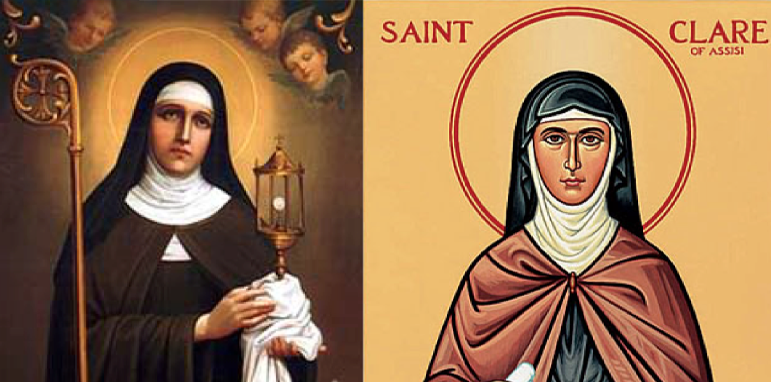
St. Clare, whose feast we celebrate today, certainly exemplifies the first image of childlike humility. As C.S. Lewis said: “Christ wants a child’s heart, but a grown-up’s head.” St. Clare of Assisi had both a child’s heart and a grown up’s head. She was born in 1193 into a rich and influential family. To the disappointment of her family and friends, Clare gave up her riches after being inspired by St. Francis when he preached at a local church. She then begged him to help her live a humble religious life.
When she was 19, she ran away to St. Francis’ chapel, cut off her hair, donned simple clothing and vowed herself to the service of Jesus. Francis placed her in a Benedictine convent. Soon her sister Agnes and others joined her. Together they lived at San Damiano Convent in Assisi, and when she was 21, Francis appointed her as Abbess, the office she held until her death.
Clare and these women became the first community known worldwide as the Poor Clares. Under Clare’s wise leadership, the community lived austerely, fasted, wore nothing on their feet, and spoke only when necessary. Later Clare persuaded her sisters to moderate this last hardship saying: “Our bodies are not made of brass.” Although she never left the convent for 41 years, she lived the radical faithfulness of the gospel message by her humility, spirituality and service to the Sisters.
In the second gospel image, that of the one lost sheep, Christ emphasizes the value and dignity of every life. As an example of this, two weeks ago, our Florida Bishops wrote a clarifying and compassionate pastoral letter on the death penalty. They write: “While recognizing the profound suffering experienced by victims of violent crime and their families, respect for human dignity extends even to those convicted of the most serious offenses. Because modern correctional systems can effectively protect society through life imprisonment without parole, the Church concludes that executions are no longer morally justified.” Our Bishops are calling all Christians to move beyond the ancient principle of “an eye for an eye” toward a higher standard based on Jesus’ teachings of mercy and respect for life. Their letter addresses many aspects and points of view of the death penalty and is worth reading.
As we honor St. Clare today for witnessing the heart of a child and the head of a grown up, and as we pray for our Bishops who are upholding the ethic of human dignity for all people, may we remember the wise words St. Clare left us:
“We become what we love
And who we love shapes what we become.”
