
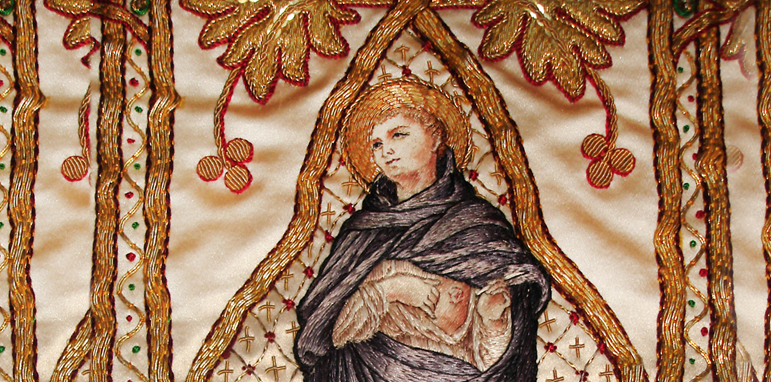
Feast day January 25
Anyone who endures dryness at prayer or feels abandoned by God will find instruction, and perhaps some relief, in the experience of Henry Suso. A mystic who called himself the “servant of Eternal Wisdom,” he endured long stretches of spiritual darkness interrupted only by occasional bursts of brightness. Henry’s life says to us that in apparent barrenness the soul draws closest to God. And we see him only by learning to look deep within.
Henry Suso was born at Constance, Switzerland, and became a Dominican there at 13. Five years later an extraordinary divine encounter launched him on his lifelong mystical pursuit of God. For the next decade, however, Suso suffered severe depression and doubt. Finally, counsel with Meister Eckhart, the patriarch of 14th-century German mysticism, delivered him from the worst of it.
Like many other mystics, at midlife Henry threw himself into active Christian work. For nearly two decades he traveled throughout the Rhineland preaching, teaching, and giving spiritual direction. He also wrote extensively about the inner life. His work on prayer, The Little Book of Eternal Wisdom, became the most popular Christian book in Europe before The Imitation of Christ appeared.
Suso’s individualistic piety and his association with Meister Eckhart, who was suspected of heresy, won him many enemies. He was accused of theft, sacrilege, fathering a child, poisoning, and heresy, but he was completely cleared of all charges. Toward the end of his life he served as the prior of the Dominican house at Ulm in central Germany. Henry Suso died there in 1366.
From: loyolapress.com
