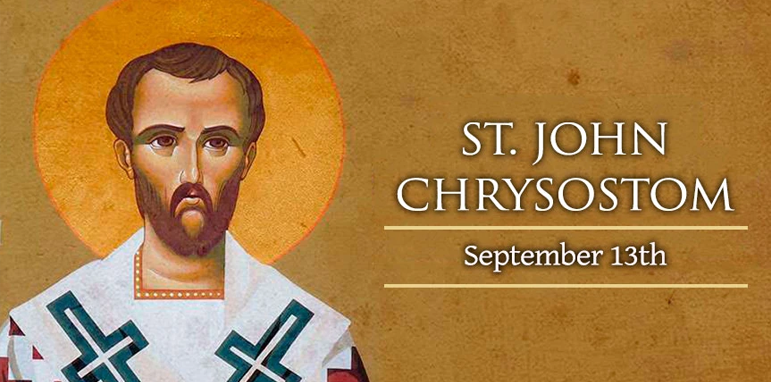
St. John Chrysostom
Feast Day: September 13
John Chrysostom was the son of a Latin father and a Greek mother; his mother, Anthusa, was widowed at the age of twenty, soon after his birth. Putting aside all thought of remarriage, Anthusa gave all of her attention to her son: she gave him the best classical education of the day, and enrolled him as a catechumen when he was eighteen. He came under the influence of Meletius, patriarch of Antioch, who sent him to the monastic school of Diodore, then baptized him and ordained him lector.
At this time, St. John Chrysostom decided to take his future into his own hands and became a monk-hermit, living in a cave, studying the Scriptures, and putting himself under the discipline of an old hermit named Hesychius. However, his health broke under this austere regimen and he returned to Antioch, was ordained a priest, and began his remarkable career as a preacher.
During the next twelve years, he electrified Antioch with his fiery sermons, filled with a knowledge and an eloquence that were astonishing. It was during this period that he received the nickname Chrysostom, or golden mouth, for his words seemed to be pure gold. In 397, when the see of Constantinople became vacant, the Emperor Arcadius appointed John patriarch, and since it was feared that he would refuse the honor, he was lured to Constantinople and consecrated bishop of the city in 398.
John found himself in a nest of political intrigue, fraud, extravagance, and naked ambition. He curbed expenses, gave lavishly to the poor, built hospitals, reformed the clergy, and restored monastic discipline. But his program of reform made him enemies, in particular the Empress Eudoxia and the Patriarch Theophilus of Alexandria. The city in turmoil, his life threatened, John was exiled by the emperor in the year 404.
The papal envoys were imprisoned, and John — defended by the pope and ordered restored to his see — was sent further into exile, six hundred miles from Constantinople, across the Black Sea. Worn out and sick, he died of his hardships at Comana in Pontus. His last words were, "Glory to God for all things."
—Excerpted from The One Year Book of Saints by Rev. Clifford Stevens
Patronage: epileptics; against epilepsy; orators, lecturers, public speakers (proclaimed on 8 July 1908 by Pope Pius X); preachers; Asola, Italy; Constantinople; Istanbul, Turkey
Symbols and Representation: Beehive; bees; dove; pen; chalice on Bible; white dove; scroll or book; pen and inkhorn; bishop's mitre
St. John Chrysostom Prayer
Almighty God, who has given us grace at this time with one accord to make our common supplications to you and promised that when two or three are gathered together in your name you will grant their requests: fulfill now, O Lord, the desires and petitions of your servants, as may be most expedient for them; granting us in this world knowledge of your truth, and in the world to come life everlasting. Amen
