
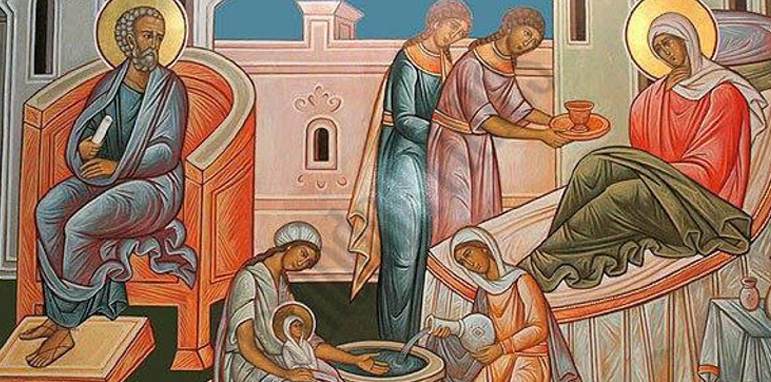
Throughout history God has chosen certain women and men for very special tasks. John the Baptist was certainly one of them. Today we remember his birth. The Church usually celebrates a saint on the day of their death, or "birth into heaven". It’s very notable, then, that the birthdays of John the Baptist, the Blessed Virgin Mary and Jesus, are the only three birthdays in the liturgical calendar that the Church celebrates. This fact alone shows how important John's nativity is to us as a faith community.
His name means ‘gift of God’, and John saw the Lord’s hand clearly during his life and even in his martyred death. He was the last prophet of the Old Testament and believed fiercely that his role was to announce and prepare the way of the Lord. That he did loudly, proudly and boldly. He spent his life doing God’s will and as a result, he gives all of us a tremendous example of fidelity. John the Baptist sowed the seeds of faith for us and we sit here today as the recipients of his labors.
It’s also interesting to note that the position of the sun in the northern hemisphere was one reason why this date, June 24, was chosen as the feast of John's birth. June 24 is just after the summer solstice when the sun is at its highest point in the sky. From now until December 24, the sun will get lower and lower in the sky. The days will get shorter and shorter.
Then, on December 25, just after the winter solstice, Jesus, the Light of the World, is born. The sun will start "rising" again and the world begins to get brighter each day. John is the "precursor”, so his birth at summer’s high point prepares us for Jesus' birth at Christmas when the world begins to get bright again.
St. Augustine comments on our gospel today. His words capture the essence of John, the man and his message:
“Zachary is struck dumb and loses his voice, until John, the Lord’s forerunner, is born and releases his voice for him. The tongue is released because a voice is being born – for when John was already heralding the Lord, he was asked, ‘Who are you’ and he replied ‘I am the voice of one crying in the wilderness’. John is the voice, but the Lord in the beginning was the Word. John is a voice for a time, but Christ is the eternal Word from the beginning.”[1]
John was a witness and a voice for Jesus. May we follow in his footsteps.
[1] St. Augustine of Hippo, s. 293.3 in Sermons vol. 8, trans. Edmund Hill (New York: New City Press, 1994), 150.
