
In our first reading we heard about the military conflicts being planned against Israel by its oppressors, terrifying plans which made “the heart of the king and the heart of the people tremble.” It is the message of Isaiah to the king and the people at the end of the reading, however, that is important. He tells them not to fear, be courageous, and trust in God. Knowing this was their only hope, Isaiah concludes: “Unless your faith is firm, you shall not be firm!”
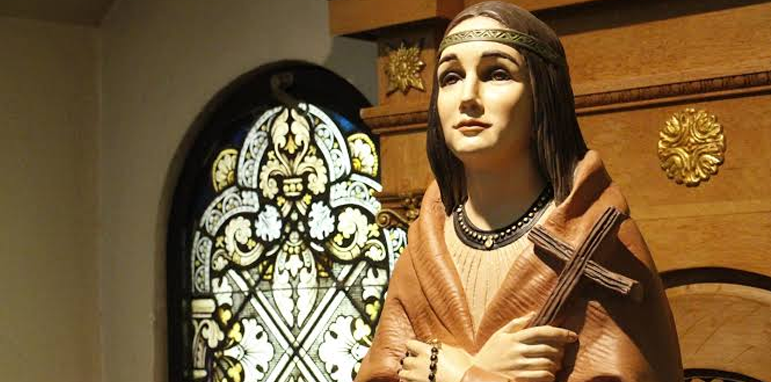
Today we celebrate St. Kateri Tekakwitha who truly lived a courageous, firm, and faith-filled life. She was born in 1656 near upstate New York. Her mother was a Christian Algonquin who was captured and given to the Mohawk chief. When Kateri was four, a smallpox epidemic took the lives of her parents and brother. This disease left her partially blind and her face disfigured. She was adopted by her uncle who became the Chief.
Jesuit priests were present in their village and Kateri was influenced by their words and ministry. She sought instruction to become a Catholic when she was 19 years old. At that time, she refused to marry, courageously asked to be converted and was baptized on Easter Sunday. The took the name Kateri, or Catherine, after St. Catherine of Siena.
Her conversion, however, cost her greatly. She was treated as an outcast and an enslaved person. Her life was always in danger because others opposed her faith. She, however, prayed, fasted, and served others lovingly.
Heeding the advice of a priest, Kateri ran away and walked 200 miles to a Christian Indian village near Montreal. There she continued to grow in holiness. She gave herself to God in long hours of prayer, charity and tireless penance for the conversion of her nation.
At age 23, Kateri took a vow of virginity, which was an extraordinary act for an Indian woman whose future depended on being married. Although she wanted to start a religious community of women, she was discouraged from doing so. Humbly, then, she led a very ordinary life.
She died at age 24 in 1680, and those present said her emaciated face changed color and became like that of a healthy, smiling child. In 2012, she became the first Native American to be canonized and named the patron saint of ecology.
What can we learn from this simple Native American young woman?
- She is certainly someone to whom we can pray for an increase in faith as we go about our ordinary days’ activities.
- She can help us grow in awareness, appreciation and respect for our Native American sisters and brothers, their history and culture.
- Her biography tells us, “She often went to the woods alone to speak to God and listen to Him in her heart and in the voice of nature.” Kateri’s example inspires us stop, notice, and care for the beauty of our common home, Mother Earth, where we see God’s presence in everything.
St. Kateri, known as the “Lily of the Mohawks”, pray for us that we may live a firm, faith life.
