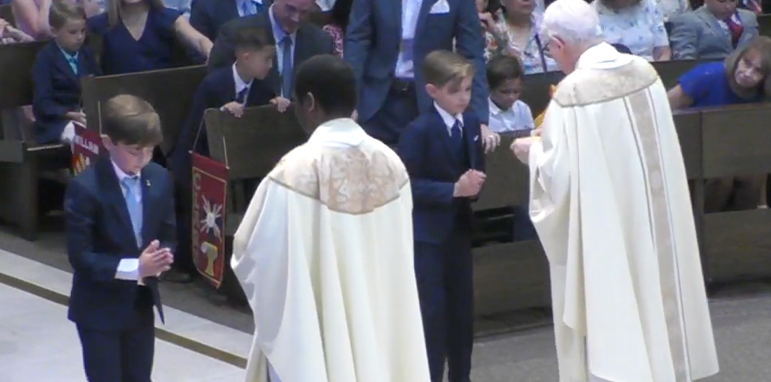
Perhaps some of you, like myself, were fortunate enough to experience the 2nd graders receiving their very First Communion last weekend. If you weren’t there, you can imagine it. Precious 7-year-olds…girls dressed in their beautiful white dresses and boys in their grown-up looking suits that, I’m sure, have been hanging and waiting in their closets for weeks. Most impressive, however, was the children’s reverence, their calm anticipation, and their fervent awe as they opened their little hands and held the Body and Blood of Christ for the first time. It was surely a special moment not only for them, but for all of us who witnessed this sacred occasion. They came to Jesus, and Jesus came to them.
In our gospel, we continue to hear Jesus trying to teach the crowds that indeed, he is “the Bread of Life”. All he wants them to do is believe and ‘come to him’, just like our precious First Communicants came to Jesus this weekend. Jesus tells the crowd that whoever “comes to me will never hunger.”
To “come to Jesus” is to bond ourselves closely to him and all he stands for. It implies much more than just “receiving Jesus in Communion”, as important as that is. To come to him also means to soak ourselves in the life of Jesus, to penetrate deeply into the Word of God that comes to us in the Scriptures, and, finally, to integrate his ways into our own lives.
Today our readings also remember one who did come to Jesus, our first saint, St. Stephen. We hear of his martyrdom because of his life’s witness to his belief in Jesus as the divine ‘bread of life’.
The deaths of both St. Stephen and Jesus have many similarities, particularly these three:
- Both Jesus and Stephen were arrested, tried before the Sanhedrin with false witnesses, questioned, and executed.
- At their trials, both Jesus and Stephen spoke of the Son of Man sitting at the right hand of God. ((Luke 22:69-70), (Acts 7:56)
- When Jesus is crucified, he prays, “Father, forgive them; for they know not what they do” (Luke 23:34). Similarly, Stephen prays for his accusers: “Lord, do not hold this sin against them” (Acts 7:60). Just before dying Jesus prays, “Father, into thy hands I commit my spirit!” (Luke 23:46). Stephen likewise prays, “Lord Jesus, receive my spirit” (Acts 7:59).
We will probably not be asked to be martyrs for Christ, but like Stephen, we can live our lives coming to Jesus every day, believing him to be the ‘bread of eternal life’, and willingly following his ways of love for all God’s people.
In a special way today, as we pray for the official beginning of the Conclave in Rome, Pope Francis’ words to us on the feast of Corpus Christi (2015) about the Eucharist are particularly meaningful: “The Eucharist is the source of love for the life of the church and a school of charity and solidarity.”
