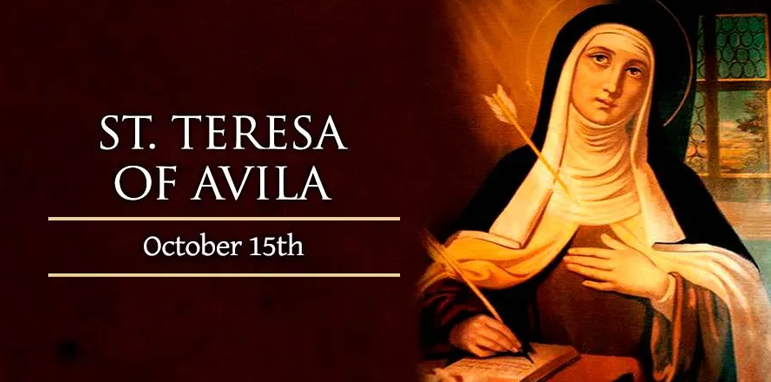
Who was St. Teresa of Avila, and why is she so revered in our church? Here are 5 things to know about this special person.
- Teresa was very human, often being described as ‘headstrong’ and ‘spunky’ with ‘a fiery Spanish soul’. Born in Spain in 1515, she caused a stir all her life, even as a child. When she was five years old, she convinced her older brother that they should go off to the land of the Moors and beg the Moors, out of love of God, to cut off their heads. They got as far as the road from their city before an uncle found them and brought them back.
- She became a mystic. As a teenager, she was beautiful, charming, and defiant. To control her, her father sent her to an Augustinian convent when she was 15. However, against her father’s will, she entered the Carmelite convent a few years later because they gave her more freedom to come and go, be with friends, etc. It was here, however, that she had a religious experience that changed her life. The convent had a new statute showing Jesus being scourged at the pillar, and when she saw that, it shook her ‘to the root of her being’. She would never be the same. Her spiritual life deepened through prayer and illnesses, and she began to experience mystical visions from Christ. Books on prayer that she wrote, including “Interior Castle”, have become classics to this day.
- She became a reformer. Through prayer, she felt God called her to reform the Carmelite Order, and so she did. She returned the Carmelites back to their original founding spirit of poverty and contemplative prayer. Eventually she established 17 convents for women, and 11 monasteries for men.
- Teresa was very approachable and relatable, despite being a mystic and a reformer. Known for her wisdom, if someone did something wrong, she’d advise them not to punish themselves – change instead. When someone felt depressed, her advice was to go someplace where they could see the sky and take a walk. Her spirituality was of love, not rules, and often had an element of humor, as when she would say: "May God protect me from gloomy saints". When someone was shocked that she ate well on occasion, she’d reply, "There's a time for partridge and a time for penance."
- Saint Teresa of Ávila was the first woman to be named a Doctor of the Church in 1970 by Pope Paul VI. At that ceremony, the Pope praised Teresa's personality, describing her as an exceptional woman and religious, stating she radiated human vitality and spiritual vivacity.
Since our parish theme is “Surrender, Be Christ, Share Christ”, it seemed appropriate to close with a simple prayer by St. Teresa which expresses this:
“Let nothing disturb you,
Let nothing frighten you,
All things are passing away:
God never changes.
Patience obtains all things
Whoever has God lacks nothing;
God alone suffices.
